Showing posts with label #chilehaus. Show all posts

Tuesday, May 23, 2017

100 Days on a Fulbright: Day 41: Chilehaus Marketing

Image from the PR page for Kontorhaus, http://www.kontorhausviertel.com/kontorhausviertel-hamburg

I'm giving a tour of the Kontorhaus this Friday. Become increasingly curious about how the marketing around the Chilehaus has always worked. Again see earlier posted poster of Chilehaus. This was based on a photograph of the building (below) was made by Hamburg-based photographer Carl Dransfeld and shaped the notoriety of the building. As Manfred F. Fischer, former head of the Hamburg monument conservation department, wrote: "It was not the Chilean architecture, but the photograph of [it] that had written art history. The invented reality was stronger than reality."

From Manfred F. Fischer: The Chilehaus in Hamburg. Architecture and vision. With 28 picture panels by Klaus Frahm, Gebr. Mann Verlag, Berlin 1999, ISBN 3-7861-2299-7.

Chilehaus photo by Carl Dransfeld (1880-1941), taken between 1924 and 1938. 


Thursday, May 04, 2017

100 Days on a Fulbright: Day 21: Love of Bldgblog

Image from Geoff Manaugh. The Washington Bridge Apartments, New York; via Google Maps.
Too eager to get to studio today so keeping this short. Back to Chilehaus tomorrow, but in the meantime, I quick nod to http://www.bldgblog.com/, one of my favorite blogs by Geoff Manaugh.

Linking directly to his post about the "constructed interior, as exotic as the savannah" at http://www.bldgblog.com/2017/04/corporate-gardens-of-the-anthropocene/. He always points out lesser noticed spaces in innovative ways. Hoping to take that approach to the Chilehaus, surrounding buildings and the city at large.

Tuesday, May 02, 2017

100 Days on a Fulbright: Day 20: Chilehaus


My proposal for my 3-country Fulbright to Germany, Chile and Hong Kong connects early 20th century buildings and their PR materials across national boundaries. Sometimes my process involves leafing through old magazines and newspapers. Other times, giving tours of the buildings and their surroundings. And on ideal days, like today, studio production, inspired by this research.

So to refocus before a studio day, a little bit more about the Chilehaus, my main muse (along with the port) here in Hamburg. Below is an excerpt from my proposal, explaining the connection.
Placed on UNESCO’s list of World Heritage Sites in 2015, the Chilehaus is a compelling, early example of infrastructure born out of the profits from international trade. Designed in the shape of a ship, the building cost a small fortune during Germany’s period of hyperinflation in the 1920s. Funded by shipping magnate Henry B. Sloman, Chilehaus developed from Sloman’s wealth amassed through his trading of potassium nitrate mined in Chile, hence the name Chile House. The Global Flex will allow me to investigate related public relation posters on both ends of the exchange, through examination of promotional materials about the Chilehaus at the University of Hamburg and the mining of potassium nitrate in Chile at the National Archive of Chile. The posters from both locations during this era display a national boosterism common in artwork from the Soviet Socialist Realist era.
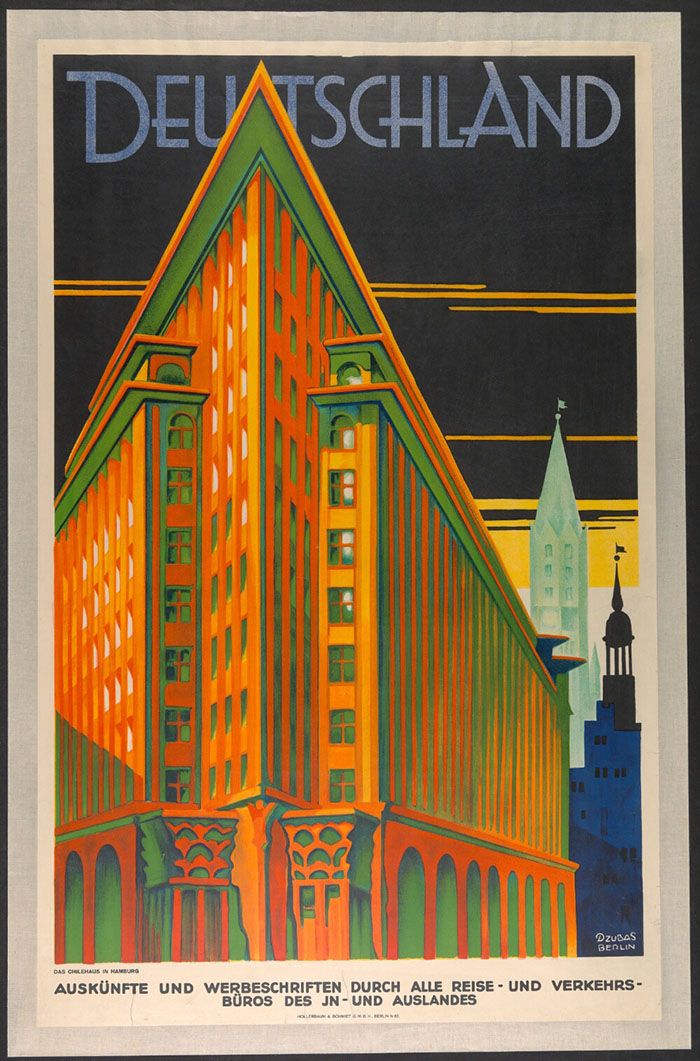
Willy Dzubas. Deutschland : das Chilehaus in Hamburg. Published by Berlin : Hollebraum und Schmidt, [1919-1945]. 
And later in my proposal:

Since my recent artwork remixes color and architecture as ways to manufacture desire, this research on posters will be combined with investigations into the history of urban planning in Hamburg. The warping architecture in my artwork from the last ten years connects to both Chilehaus’ location in the Speicherstadt and Kontorhaus District, with its series of complex tunnels, canals, and warehouses, and the Chilehaus itself, with its sharp peak at its front that mimics a ship’s prow. These oblique structures, evident in Höger’s 1924 building and often celebrated in contemporary, computational architecture, mimic the both the intentionally obtuse structures of contemporary networked systems and the structure of the sea itself. Geographer Phil Steinberg writes that linear, descriptive narratives are inadequate for portraying trade, which is a process of betweeness even as it incorporates tangible objects, actors, and power dynamics. Furthermore, he argues that linear narratives are unable to capture either the social or the geophysical power of the ocean, which has a depth and dynamism that defies representation, or of the ports that exist in constant interchange between ideals of solid land and liquid sea. In keeping with this critique, I seek to produce artworks with structures that reflects this liminal state—between representation and abstraction, male and female, analog and digital—through paintings that suggest movement and short animations in motion.


Friday, April 28, 2017

100 Days on a Fulbright: Day 15

Vito Acconci inside one of his modules for “Project for Klapper Hall,” from 1993-95.Credit Fred R. Conrad for The New York Times

Sad to hear of Vito Acconci's passing. Much of his work resonates with me, including his unexpected turn to public art that plays with our expectations for architecture. Two quotes from the New York Times review about his life:

1) In reference to his "Following Piece" from 1969:
“It was sort of a way to get myself off the writer’s desk and into the city,” he once told the musician Thurston Moore. “It was like I was praying for people to take me somewhere I didn’t know how to go myself.”
How I feel about my class at HFBK. It structures my research and forces me out of the studio to meet locals and see the city.

2) His career turn:
That ambition took hold fully in the mid-1970s, when, in a radical career turn, he abandoned the gallery world and remade himself as a highly unorthodox architect and designer, creating works like public parks, airport rest areas and even an artificial island on a river in Austria. 
The move confused his peers and caused his profile in the art world to recede, to the point where many younger artists who were indirectly influenced by his work had little idea who had created it. In his later years, Mr. Acconci sometimes agonized over this situation, but he said he had no choice but to follow his interests where they took him — which was no less than an ambition to change the way people lived.
3) His approach to architecture:
“I wish we could make buildings that could constantly explode and come back in different ways,” he said in one interview. “The idea of a changing environment suggests that if your environment changes all the time, then maybe your ideas will change all the time. I think architecture should have loose ends. This might be another problem with Modernism — it’s too complete within itself.”
Why I'm studying the Chilehaus, but more about that in another post.

“Murinsel,” a floating platform in Austria designed by Mr. Acconci. DeAgostini/Getty Images
CrediDeAgostini/Getty Images