


More about my Fulbright Global Scholar Award to Germany, Chile and Hong Kong
More about the Fulbright Global Scholar Award in general
 |
| Agnes Martin. “Summer” (1964): Synthesizing both Abstract Expressionism and minimalism. From Peter Schjeldahl’s 2016 article in the New Yorker titled “Agnes Martin, a Matter-of-Fact Mystic.” By Peter Schjeldahl, https://www.newyorker.com/magazine/2016/10/17/agnes-martin-a-matter-of-fact-mystic |
“Nourish yourself with grand and austere ideas of beauty that feed the soul… Seek solitude,” young Delacroix counseled himself in 1824. Keats saw solitude as a sublime conduit to truth and beauty. Elizabeth Bishop believed that everyone should experience at least one prolonged period of solitude in life. Even if we don’t take so extreme a view as artist Agnes Martin’s assertion that “the best things in life happen to you when you’re alone,” one thing is certain: Our capacity for what psychoanalyst Adam Phillips has termed “fertile solitude” is absolutely essential not only for our creativity but for the basic fabric of our happiness — without time and space unburdened from external input and social strain, we’d be unable to fully inhabit our interior life, which is the raw material of all art.She’s talked about it through the lens of many artists and writers. I’m especially attracted to the following posts:

 |
| Keller Easterling's 2014 book Extrastatecraft. https://www.versobooks.com/books/2163-extrastatecraft |
 |
| Elisabeth Condon, Unnatural Life, 2016. Acrylic and ink on linen, 54 x 72 inches. Courtesy Emerson Dorsch Gallery, Miami, Florida/Phillip Reed. |
 |
| Elisabeth Condon, Housing Unit, 2016. Watercolour, 22 x 30 inches. Courtesy Emerson Dorsch Gallery, Miami, Florida/Phillip Reed. |
 |
| Elisabeth Condon, Love, American Style, 2016. Acrylic on linen, 54 x 72 inches. Courtesy Emerson Dorsch Gallery, Miami, Florida/Phillip Reed. |
 |
| Ferdinand Ahm Krag. Waves Over Graves. 2011. Mixed Media. 223.3 by 239.6 cm. |
 |
| House of Three Brothers / marker on paper - 2016. http://www.erindiebboll.com/projects/7_house_of_three_brothers.html |
 |
| Thirty Years - Basement / pencil on paper - 50 x 96 inches - 2010. http://www.erindiebboll.com/projects/4_basement.html |
 |
| Voyage 51E / pencil on paper, metal frames - dimensions variable - 2016. http://www.erindiebboll.com/projects/8_voyage_51E.html |
 |
| Image: Tyler Coburn. Organic Situation, Koenig & Clinton, New York, 2015. Installation view. |
 |
| Mari Bastashevski. Excerpt Chapter II. 2012-13. http://maribastashevski.com/?/state-business/Chapter-II/ |
 |
| Mari Bastashevski. Stack of books for container artist residency. 2016. http://www.containerartistresidency01.org/artists/mari-bastashevski/#travelogue |
 |
| Allora & Calzadilla, Puerto Rican Light (Cueva Vientos), 2015, solar-powered batteries and charger, plywood crate, Dan Flavin’s Puerto Rican light (to Jeanie Blake) 2, 1965. Installation view, El Convento Natural Protected Area, Puerto Rico, 2015–17. Photos: Allora & Calzadilla. |
“Mario Pedrosa, the Brazilian art critic and museum curator, has gone to Chile in order to found there a museum of solidarity between the artists and the experiment of the country, Chile, itself. Some six hundred works of art have already arrived in Chile, among them Mirós, Calders, Vasarelys, and Stellas. Mario Pedrosa has asked me to send his quest to artists of Documenta 5, and the painters and sculptors known to me, in order to help create an activity for this museum of solidarity by means of works of art and the creation of a collection, which alone would justify the construction of a new building. I would be grateful if you could support this project with your thought and your assistance. With best regards, Harald Szeemann.” In the same letter—written on a continuous strip of paper and postmarked California, U.S.A.—Baldessari incorporated the text: “Dear Mario Pedrosa. Please let me know what I can do to aid in the creation of your museum and how I go about it. Sincerely yours, John Baldessari.”In the current issue of Artforum magazine, Irene Small describes another artwork born of transnational concerns, Allora & Calzadilla’s 2015 installation titled Puerto Rican Light (Cueva Vientos), which places Dan Flavin’s 1965 Puerto Rican light (to Jeanie Blake) 2, 1965 in El Convento Natural Protected Area, Puerto Rico with solar-powered lighting. She asks:
But what is a source, what is a site? Flavin’s title was inspired by a remark by Jeanie Blake, a gallery assistant who noted that the sculpture reminded her of “Puerto Rican lights.” Ostensibly, Blake was referring to New York’s Puerto Rican Day Parade, but the sculpture’s palette of red, pink, and yellow intimates a more amorphous string of associations, ranging from tropical sunsets to piña coladas (invented the same year colored fluorescents appeared, 1963). The parade was itself something of a novelty, a by-product of the dramatic surge in Puerto Rican immigration to New York City in the 1950s and ’60s, spurred by the manufacturing and export initiative Operation Bootstrap. The electrical current that would normally activate the gaseous contents of a fluorescent tube, meanwhile, represents an even more diffuse network, a single point in a vast infrastructure of governmental and corporate relations. The conceptual audacity of Flavin’s light works lies in no small part in gathering this tentacular web and transforming it into an evanescent envelope of space—a glow, heat, and hum—that, quite unlike the invisible network that looms beyond it, can be experienced at bodily scale.Then she outlines the relationship between the minimalist artwork to the landscape outside the cave, much in the way the factories of New York City and Beacon provide a telling backdrop to the Minimalist and post-Minimalist work of Dia Beacon.
For Allora & Calzadilla, the correlation between art and industrialization becomes explicit—albeit through a process of defamiliarization and displacement. En route from San Juan to Cueva Vientos, one passes abandoned sugar-processing plants and leaking petrochemical complexes, each evidence of the economic asymmetry that continues to structure Puerto Rico’s relation to the mainland. Obsolescence emerges as a historical rather than aesthetic frame, one that admits the deep entanglement of colonialism, capitalism, and industrialization. Once we enter the El Convento cave system, our temporal frame dilates, and we trace the reverse route of the ancient Taíno, ascending through a forest of primeval trees to caves populated by bats and boa constrictors, seeking shade and sun in turn.Again I come back to this wild flux between abstraction and representation around and within contemporary artworks and the constant digital stream of imagery. As we work on this game about the port and I struggle to present that topic in a way that has yet to be told, I think about how artworks might most effectively represent the larger invisible networks that Small describes.
 |
| Laura Kalauz, Maja Leo, Bojan Djordjev and New Urgency. Said to Contain, series of events about global trade, 2013-present. https://saidtocontain.org/ |
 |
| Owen Mundy. I Know Where Your Cat Lives. 2014-present. http://iknowwhereyourcatlives.com Image from here. |


 |
| Gabrielle Jennings. Abstract Video: The Moving Image in Contemporary Art. 2015. |
The first was an exhibition by New York School poet and artist Joe Brainard. Through this exhibition, I was introduced to the poet John Ashbery. Even then, I had a fascination with the empty spaces in his writing, with the ways he used typography and allusion for powerful ends. Looking back, my interest in and use of blankness both in my studio work and in my master’s thesis, “Stillness and Simultaneity,” was influenced by Ashbery’s work. Later I would work closely with the painter and writer Jeremy Gilbert-Rolfe, whose writing appears in this volume and whose work has also been a profound influence on my thinking about art. In his 1997 article Blankness as a Signifier, he wrote, “Where [blankness] once marked the absence of the sign by being a sign for absence, it is now the sign of an invisible and ubiquitous technological presence.” This volume teases out this presence: an indefinable, murky space, foggy and immaterial like a Turner painting; an abstraction that appears in the moment of a frame and then disappears only to be replaced by another.Gabrielle Jennings teaches at Art Center College of Design, Pasadena, CA.

 |
| Image from Geoff Manaugh. The Washington Bridge Apartments, New York; via Google Maps. |

Placed on UNESCO’s list of World Heritage Sites in 2015, the Chilehaus is a compelling, early example of infrastructure born out of the profits from international trade. Designed in the shape of a ship, the building cost a small fortune during Germany’s period of hyperinflation in the 1920s. Funded by shipping magnate Henry B. Sloman, Chilehaus developed from Sloman’s wealth amassed through his trading of potassium nitrate mined in Chile, hence the name Chile House. The Global Flex will allow me to investigate related public relation posters on both ends of the exchange, through examination of promotional materials about the Chilehaus at the University of Hamburg and the mining of potassium nitrate in Chile at the National Archive of Chile. The posters from both locations during this era display a national boosterism common in artwork from the Soviet Socialist Realist era.
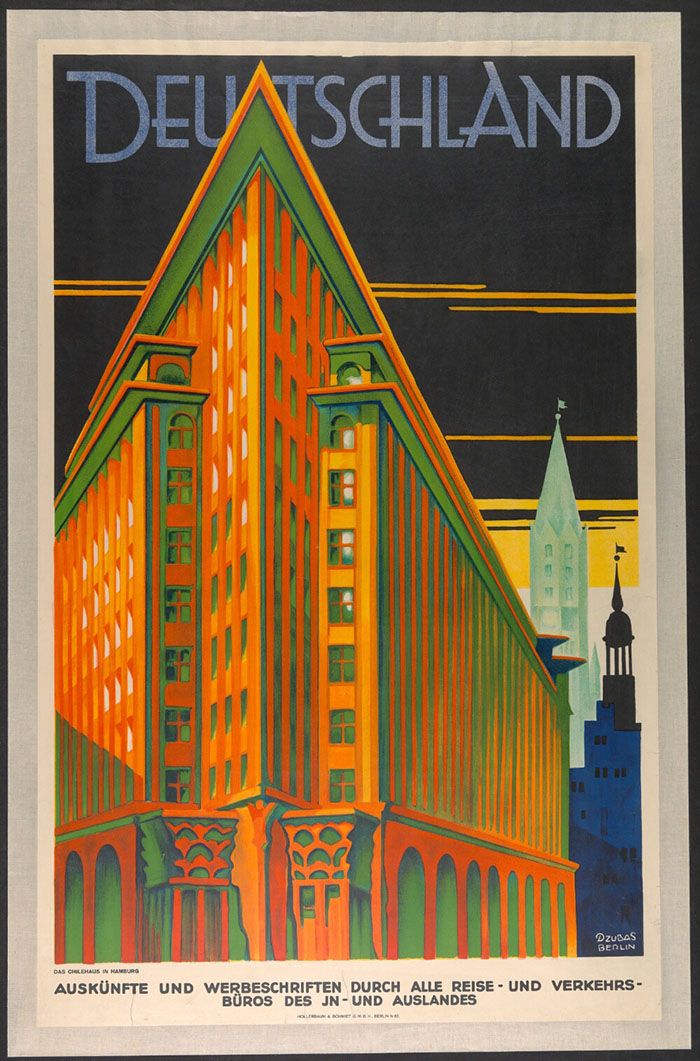 |
Willy Dzubas. Deutschland : das Chilehaus in Hamburg. Published by Berlin : Hollebraum und Schmidt, [1919-1945].
|
Since my recent artwork remixes color and architecture as ways to manufacture desire, this research on posters will be combined with investigations into the history of urban planning in Hamburg. The warping architecture in my artwork from the last ten years connects to both Chilehaus’ location in the Speicherstadt and Kontorhaus District, with its series of complex tunnels, canals, and warehouses, and the Chilehaus itself, with its sharp peak at its front that mimics a ship’s prow. These oblique structures, evident in Höger’s 1924 building and often celebrated in contemporary, computational architecture, mimic the both the intentionally obtuse structures of contemporary networked systems and the structure of the sea itself. Geographer Phil Steinberg writes that linear, descriptive narratives are inadequate for portraying trade, which is a process of betweeness even as it incorporates tangible objects, actors, and power dynamics. Furthermore, he argues that linear narratives are unable to capture either the social or the geophysical power of the ocean, which has a depth and dynamism that defies representation, or of the ports that exist in constant interchange between ideals of solid land and liquid sea. In keeping with this critique, I seek to produce artworks with structures that reflects this liminal state—between representation and abstraction, male and female, analog and digital—through paintings that suggest movement and short animations in motion.


Altona_Hamburg_Harburg.png)