Advertising - Speaking to Imagination and Emotion to Sell Paint - NYTimes.com
As I continue to prepare The Sherwin Series for my Colorado State University exhibition, Denis Wood brought this NY Times article to my attention. Spot on.
Does anyone know the German equivalent to Sherwin Williams and Benjamin Franklin paints? I need the local pop culture references on top of my color research at the Bauhaus Archives.
Tuesday, June 08, 2010


Sunday, June 06, 2010
Expat Artists: The Creative Life Abroad � Expat Arts

Expat Artists: The Creative Life Abroad at Expat Arts
Another report on artists living overseas as we're about to spend a year in Berlin. Of course, there's a long history of this.
One example—Cy Twombly lives half his year in Lexington, Virigina and half in Rome, Italy and has done so for decades. I could totally do that. By the way, the Museum Brandhorst in Munich open May 2009. It has the most impressive Cy Twombly room I have seen, second to the the front room of the Cy Twombly Museum in Houston. Above is a picture that I took of the outside of the Museum last winter holiday break. Go visit!
UCSD Open Studios: James Enos

James Enos, The 2-Towers / Clairemont Erasure
UCSD Open Studios: James Enos
Reminds me of my housing forms...
Expat Early Returnees Survey
A professor in Canada just asked me to post this survey. Hopefully you'll have some time to help her out.
Expat Early Returnees – Please Help!
Have you and your family ever returned home early from an international assignment? Do you know someone else who has? Dr. Nina Cole, an Associate Professor from Ryerson University in Toronto is inviting early returnees to participate in her study of early returns from home from the perspective of the families involved. This information is critical in order to help reduce the often-painful circumstances behind early returns through better pre-assignment preparation. Please visit http://ninacole.net before June 30, 2010 and click on ‘Expat Questionnaire’ (short, anonymous and confidential). Questions can be directed to Dr. Cole at n2cole@ryerson.ca. Your participation would be very much appreciated.
Expat Early Returnees – Please Help!
Have you and your family ever returned home early from an international assignment? Do you know someone else who has? Dr. Nina Cole, an Associate Professor from Ryerson University in Toronto is inviting early returnees to participate in her study of early returns from home from the perspective of the families involved. This information is critical in order to help reduce the often-painful circumstances behind early returns through better pre-assignment preparation. Please visit http://ninacole.net before June 30, 2010 and click on ‘Expat Questionnaire’ (short, anonymous and confidential). Questions can be directed to Dr. Cole at n2cole@ryerson.ca. Your participation would be very much appreciated.
Friday, May 28, 2010
Katamari Damacy + Heinz Galinski School
I'm at the stage in my current project where mid-process, similar forms + unknown influences come to the foreground. Noting the following:


Writing at http://joelledietrick.com/site/sherwin/
Draft(!) of catalog for Colorado State University solo exhibition (fall 2010) at http://www.blurb.com/bookstore/detail/1337954
Katamari Damacy (Brian Alfred suggest it. Thanks Brian!)
Heinz Galinski School, Berlin, 1995, Zvi Hecker (1st Jewish school to be built in Berlin since WWII)
New work, Study for Sherwin's Virtual Re-Mix 05
Writing at http://joelledietrick.com/site/sherwin/
Draft(!) of catalog for Colorado State University solo exhibition (fall 2010) at http://www.blurb.com/bookstore/detail/1337954
Tuesday, May 25, 2010
Everything You Ever Wanted to Know But Were Afraid to Ask
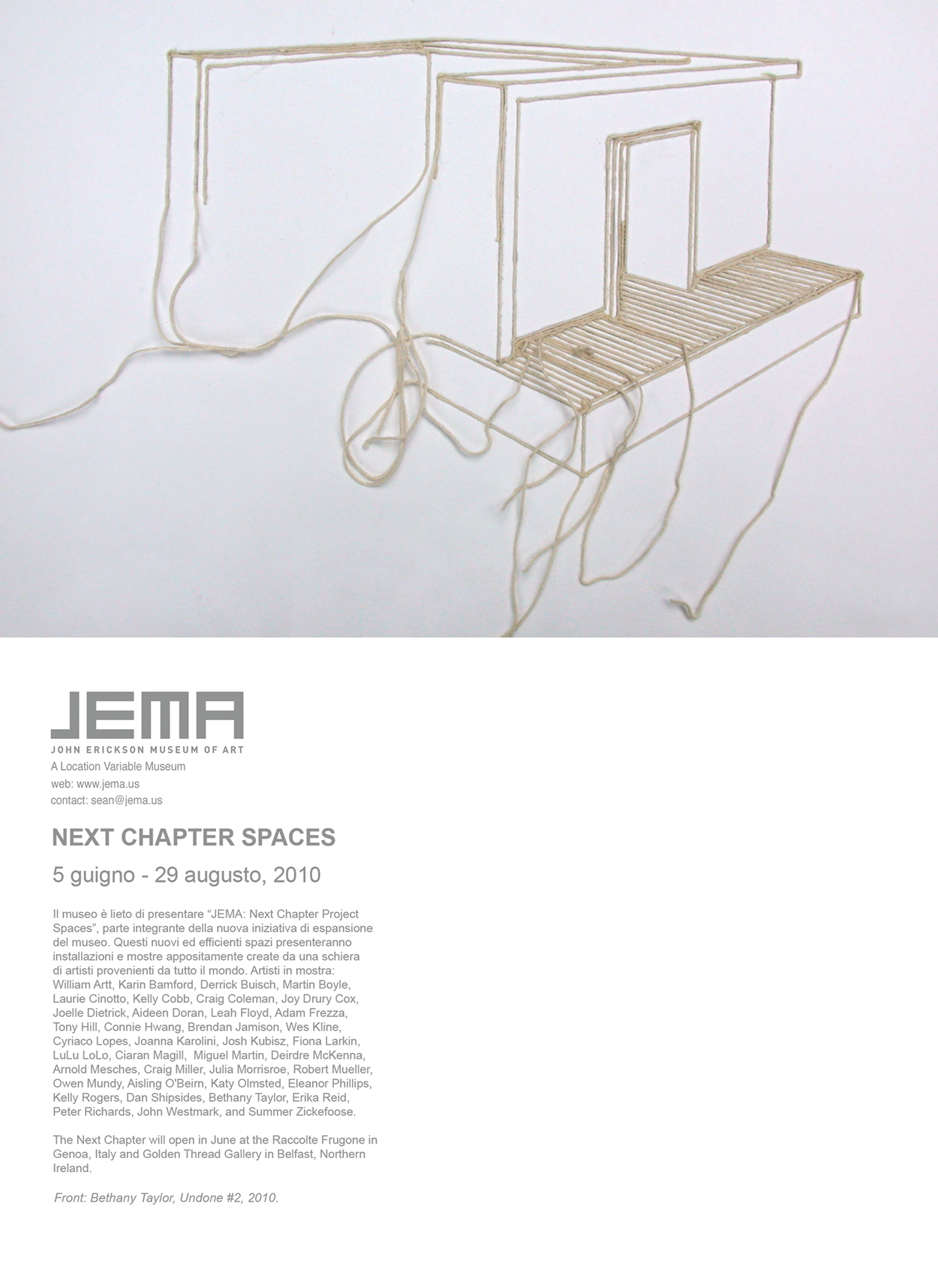
Owen Mundy and I sent images this week to two international group shows at the Golden Thread Gallery in Belfast, Northern Ireland, U.K. and the Raccolte Frugone Museum in Genoa, Italy. We were invited to submit proposals that “could not be realized” to Sean Miller, who curated the exhibitions as part of his John Erickson Museum of Art project.
Our process involved first constructing a 3-dimensional model of the space. Owen did this using Google SketchUp.

Then we filled this template with our proposals. Two variations resulted.
JEMA.3333, 11×8.5″, archival inkjet on paper, 2010

Everything You Ever Wanted to Know But Were Afraid to Ask, 11×8.5″, archival inkjet on paper, 2010

Exhibition card
Museum All-Over
June 4-August 29, 2010
John Erickson Museum of Art: Next Chapter and
Raccolte Frugone Museum
Genoa, Italy
Little Wonder
June 4-June 17, 2010
John Erickson Museum of Art: Next Chapter and
Golden Thread Gallery
Belfast, Northern Ireland
U.K.
Our process involved first constructing a 3-dimensional model of the space. Owen did this using Google SketchUp.
Then we filled this template with our proposals. Two variations resulted.
JEMA.3333, 11×8.5″, archival inkjet on paper, 2010
Everything You Ever Wanted to Know But Were Afraid to Ask, 11×8.5″, archival inkjet on paper, 2010
Exhibition card
Museum All-Over
June 4-August 29, 2010
John Erickson Museum of Art: Next Chapter and
Raccolte Frugone Museum
Genoa, Italy
Little Wonder
June 4-June 17, 2010
John Erickson Museum of Art: Next Chapter and
Golden Thread Gallery
Belfast, Northern Ireland
U.K.
Thursday, May 13, 2010
Thin Cities: New Favorites
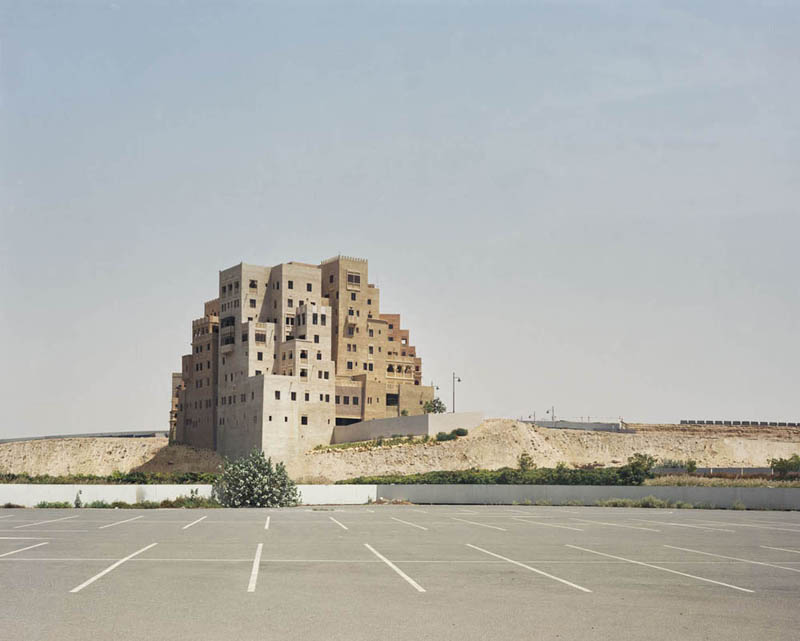
I have to bring Bldgblog to my readers' attention yet again. Look at these photographs by Bas Princen. They are in the same spirit as my Thin Cities series, but all the more powerful because they are real, on the outskirts of cities in unlikely arrangements. The Storefront for Art and Architecture writing about the photographs says it best.
Although it is the result of extensive travels and research in five cities of the Middle East and Turkey—Istanbul, Beirut, Amman, Cairo and Dubai—it could just as easily pass as the pictorial record of a dérive through a single, imaginary city: a city without a center, populated by extraordinary and at times implausible architectural artefacts; an urban laboratory whose physical traits are defined by migratory flows, spatial transformation and geopolitical flux on a continental scale.
Tuesday, April 13, 2010
Global Relocation Trends Just Released
Thanks for Andrea at expatwomen.com highlighting the latest trends in Brookfield's Annual Global Relocation Trends survey.
expatwomen.blogspot.com
expatwomen.blogspot.com
Monday, March 08, 2010
This blog has moved
This blog is now located at http://female-expat.blogspot.com/.
You will be automatically redirected in 30 seconds, or you may click here.
For feed subscribers, please update your feed subscriptions to
http://female-expat.blogspot.com/rss.xml.
Tuesday, March 02, 2010
Bldgblog Book

Phil Steinberg has been kind enough to lend me the Bldgblog Book, and I can't get enough of Geoff Manaugh's writing. Since the book consists of his blog posts on http://bldgblog.blogspot.com/ since 2004, you can easily dive into the book wherever you are inspired. I skipped ahead to and fell in love with the chapter called Redesign the Sky.
Although generally inspired by architecture, his approach to content is refreshing. As he describes in the intro:
In other words, forget academic rigor. Never take the appropriate next step. Talk about Chinese urban design, the European space program, the landscape in the films of Alfred Hitchcock in the span of three sentences -- because it's fun, and the juxtapositions might take you somewhere. Most importantly, follow your lines of interest.
Soon to talk about my own artwork in St Louis, I'm aware that leaps between seemingly disparate topics often drives my own practice. I hope I can communicate my brain's logic with the same convincing elegance as Manaugh.
Monday, February 08, 2010
Tallest Skyscraper by a Woman

Aqua by Jeanne Gang
Friend / blogger Jenn Mowery Marsh brought this New Yorker article and gorgeous piece of architecture by Jeanne Gang to my attention. Favorite bits from article in case you are in a rush...
- A lot of attention—in Chicago, at least—has been given to the fact that Aqua is the tallest building in the world designed by a woman. That’s nice for Gang, but beside the point, and dwelling on it leads too easily to predictable interpretations of skyscrapers as symbols of male identity...
- balconies on every floor, all the way up. Usually, condominiums sixty or seventy floors above the street don’t have balconies, because it’s just too windy up there to go outside...
- you might think it’s a gigantic version of one of those “blob” buildings of the past few year
- In an age in which so much architectural form—even, sometimes, the best architectural form—has no real rationale beyond the fact that it is what the architect felt like doing, there is something admirable about the tower’s lack of arbitrariness. It reclaims the notion that thrilling and beautiful form can still emerge out of the realm of the practical.
Read more at...
I see my revisitation of practically placed, undulating forms in my artwork's future.
Saturday, January 16, 2010
Hans Bellmer + Hysteria

Today I’m reading about Hans Bellmer and seeing parallels between his photographs and my recent paintings bulging with balls of figures and objects in domestic spaces. Therese Lichtenstein’s writing about Bellmer in a chapter called “The Hysterical Body” in her book Behind Closed Doors easily links Peter Kilborn’s Relos and expatriates’ nomadic tendencies. These commonly reward lifestyles appear normal but are often only seem slightly less frenetic and prone to emotional, animal-like behaviors. From page 108:
Once again, as in so many of Bellmer’s photographs, this body is riven by inner conflict...both trapped and out of control in the claustrophobic space. And once again, this headless hybrid creature (like octopus and a human combined) suggests the condition of hysteria. By portraying the doll as headless and flailing, Bellmer seems to collude with class nineteenth-century stereotypes of hysterics as woman who have lost their minds, who are emotional and animal-like in nature, and who are literally out of control.
Although the interpretations of hysteria and many of its symptoms have changed in various ways from Greek times to the present, and it has affected both men and women, hysteria has been consistently characterized as a female malady. What we call hysteria today is a psychosexual abnormality that manifests itself through an assortment of physical symptoms. The word hysteria derives from the Greek hyster (womb) and was used in ancient Greece to designate a pathology presumed to result from a displaced or “wandering” womb. The Greeks believed that in cases involving an insufficient amount of sexual intercourse or even sexual abstinence, the womb would become uprooted and wanter around the woman’s body, producing negative behavioral side effects. Women who did not conform to the conventional roles assigned in patriarchal culture—namely, wife and fertile mother—were pathologized...
In most Western cultures in the nineteenth century...according to diagnostic science of the period, the female hysteria registered her symptoms across her body through a nonverbal language f gestures that expressed her unconscious anger and rebellion. These passionate physical tremors, like the pent-up energy of an earthquake rocked her otherwise contained and controlled body.
Such antisocial characteristics were first “documented” in photographs taken under the direction of the famous French psychologist Jean-Martin Charcot at the Salpetriere clinic between 1875 and 1880...hysterical fits were induced by electrical shock, loud noises, pressure on the ovaries, the use of ether, tying women down, or placing their heads in a brace in order to hold a pose for the long exposure time. The cultural historian Sigrid Schade points out that it is not a coincidence that many nineteenth-century hysterical poses resembled epileptic fits, because after 1870 Charcot place epileptic patients and hysterics in the same ward. Many gestures, especially the “hysterical” arched back, resembled depictions of women possessed by demons or images of exorcism found in earlier medieval and Renaissance paintings. Charcot, who was married to a wealthy widow and wa sa patron of the arts, closely connected to Parisian art circles, collected these works and hung them on the walls of the Salpetriere clinic, where patients had visual access to them.
More about Lichtenstein's book at http://ucpress.edu/books/pages/8186.php
A 2006 New York Times article with a painting of Charcot talking about the "disappearance" of hysteria, a fashionable syndrome of the Victorian era...or the changing of its name. http://www.nytimes.com/2006/09/26/science/26hysteria.html
Saturday, December 19, 2009
Exact Coordinates of Home
"As far as one journey, as much as a man sees, from the turrets of the Taj Mahal to the Siberian wilds, he may eventually come to an unfortunate conclusion—usually while he's lying in bed, starting at the thatched ceiling of some substandard accommodations in Indochina," writes Swithin in his last book, the posthumously published Whereabouts, 1917 (1918). "It is impossible to rid himself of the relentless, cloying fever commonly known as Home. After seventy-three years of anguish I have found a cure, however. You must go home again, grit your teeth and however arduous the exercise, determine, without embellishment, your exact coordinates at Home, your longitudes and latitudes. Only then, will you stop looking back and see the spectacular view in front of you."
From Special Topics in Calamity Physics by Marisha Pessl. I'm having trouble finding the original source, but worthy of a post.
From Special Topics in Calamity Physics by Marisha Pessl. I'm having trouble finding the original source, but worthy of a post.
Wednesday, December 02, 2009
The Rotating Kitchen by Zeger Reyers
Also my inclination for making artwork right now. Spot on.
See documentation of Reyer's The Rotating Kitchen on vimeo.
See documentation of Reyer's The Rotating Kitchen on vimeo.
Janine Antoni

Listening to some podcasts while I'm working at the artist residency in Austria. These comments from Janine Antoni from MOMA Reconsidering Feminism, buried somewhere in their iTunes Think Modern series, rang true today.
Gender is not something that I manufacture from a historical or theoretical perspective. It's actually something that surprises me in the work. It doesn't come from some sort of pre-conceived notion. It's is only the unconscious imagination that would wake up to find their mother dressed up as their father and vice versa. It’s only from this place that I can imagine doing the laborious task of mopping the floor with my hair or making lipstick out of six hundred pounds of chewed chocolate. It's sort of this confusion...this misunderstanding that I find illuminating... I'm not talking about a kind of non-thinking or idiot savant attitude, but I'm talking about...the unconscious as a kind of a product of the conscious mind...and the conscious mind that's done a lot of work on this issue that is very aware of the way that I'm treated in the world as a woman. A conscious mind that sort of watches how gender plays itself out in the world. It's my belief that in liberating the imagination is the only way that I can envision some other possibility.
Thursday, November 26, 2009
Plant Passport
Much of the landscape where I've lived for the past three years, can look like this:
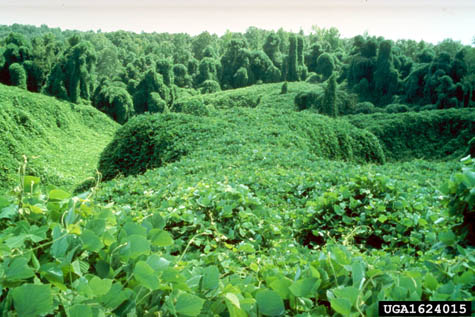
[Image: Kudzu-infested forest; photo courtesy John D. Byrd, Mississippi State University].
Even waterways, now becoming choked with Pondweed, make you wonder who has the upper hand. Occasionally plants appear to be winning, especially when the current economy yields little money to maintain infrastructure. Even during my first month in the region, plants started working their way into my paintings. Now they are really coming into themselves, like the plants barreling through Munich's Haupbahnhof in this recent painting:

Swarm Separating Self: Haupbahnhof Pondweed, Ink on vellum, 10x45 in, 2009

Swarm Separating Self: Haupbahnhof Pondweed, Ink on vellum, 10x45 in, 2009 (detail)
The dense, defiant roots of these plants stood in perfect contrast to the rootless female figures of my imagined worlds. But then this morning, to stumble upon on a fantastic conversation on Bldgbldg blog with Plant Health and Quarantine Officer for the Royal Botanic Gardens at Kew about Plant Passports...all this while reading Michael Pollan's Botany of Desire. I couldn't be more pleased.
[Image: Kudzu-infested forest; photo courtesy John D. Byrd, Mississippi State University].
Even waterways, now becoming choked with Pondweed, make you wonder who has the upper hand. Occasionally plants appear to be winning, especially when the current economy yields little money to maintain infrastructure. Even during my first month in the region, plants started working their way into my paintings. Now they are really coming into themselves, like the plants barreling through Munich's Haupbahnhof in this recent painting:

Swarm Separating Self: Haupbahnhof Pondweed, Ink on vellum, 10x45 in, 2009

Swarm Separating Self: Haupbahnhof Pondweed, Ink on vellum, 10x45 in, 2009 (detail)
The dense, defiant roots of these plants stood in perfect contrast to the rootless female figures of my imagined worlds. But then this morning, to stumble upon on a fantastic conversation on Bldgbldg blog with Plant Health and Quarantine Officer for the Royal Botanic Gardens at Kew about Plant Passports...all this while reading Michael Pollan's Botany of Desire. I couldn't be more pleased.
Thursday, November 12, 2009
New Books on Painting

Katharina Grosse, Untitled, 2004, acrylic on wall, floor, and various objects, approx. 110 × 177 × 158 in (280 × 450 × 400 cm)
New books on painting:
Painting Today
Painting Abstraction
Both from Phaidon.
Off to Austria to work on my paintings. Hurrah!
Also from Painting Today

Matthias Weischer, Oberlicht, 2006, oil and egg tempera on canvas, 120 x 150 cm (47¼ x 59 in)