Begun during my adventures overseas, the Female Expat Project began as a collection of artworks about female expatriates and their original ideas about place. On the flip side of expatriates' nomadic lifestyles are contemporary nesting instincts—also explored in this blog. Really it's a publicly available sketchbook in the cloud supporting my artwork. http://joelledietrick.com
Wednesday, December 05, 2012
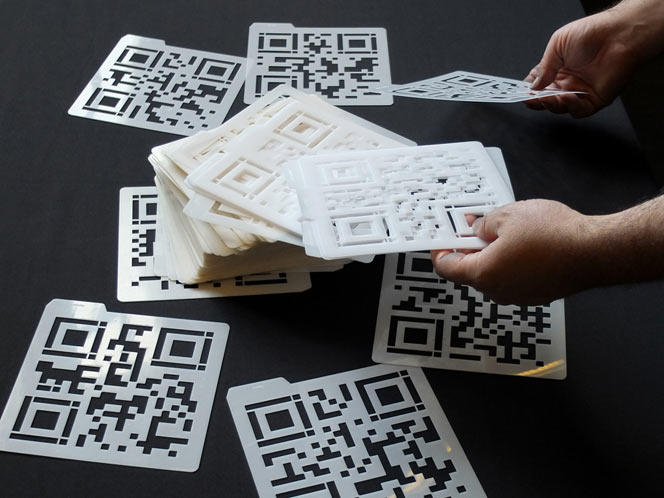
QR Codes for Digital Nomads
QR Codes for Digital Nomads - Interactive Art by Golan Levin and Collaborators
2011 | Golan Levin and Asa Foster III, for F.A.T. Lab
Thursday, November 01, 2012
Modular Abstraction: A Q&A with Judy Rushin
Modular Abstraction: A Q&A with Judy Rushin on the New American Paintings/Blog
Art for the female expat: "site-specific works that can travel well"...[and]..."reflect our own untethered geographies."
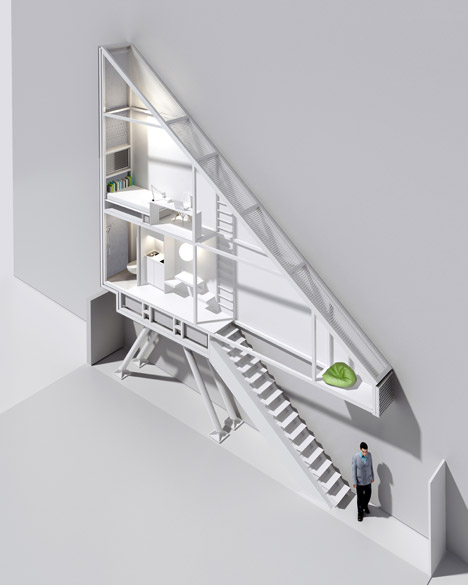
World's Narrowest House
Keret House
World's Narrowest House by Jakub Szczesny
"The house is located between two buildings from two historical epochs. “The first is a brick building on Zelazna Street – a fragment of the pre-world war II city, almost no longer existing. The second – a cooperative concrete apartment building, an element of an “imposed structure”, which was aimed at negating the previous city landscape."
Sunday, October 28, 2012
John Yau on Wade Guyton
http://hyperallergic.com/59288/hidden-in-plain-sight-wade-guytons-dirty-pictures/
![]() |
Wade Guyton, “Untitled” (2006). Epson UltraChrome inkjet on linen; 90 × 53 in. (228.6 × 134.6 cm). Collection of Mark Grotjahn and Jennifer Guidi. ©Wade Guyton. Photograph by Lamay Photo.
Reverence, citation, mimicry, the absence of the hand, and a destructive impulse — all familiar postmodern positions — coexist in Guyton’s inkjet paintings...his incredibly productive lack of creativity fits right into the by now familiar and even petrified art historical narrative that claims that de-skilling, appropriation, and post-Duchampian/post-studio practice are the only games in town, that everything else is a failure not worth considering.
Monday, October 15, 2012
Saturday, September 29, 2012
Friday, September 21, 2012
Wednesday, September 12, 2012
Wednesday, August 22, 2012
Documenta 13 Review
Some photos from our excursion at Documenta 13 in Kassel, Germany
Top 5
1. Cardiff / Miller at the train station
2. Theaster Gates at the Hugenot House
3. William Kentridge (not pictured below)
4. Michael Rakowitz
5. Geoffrey Farmer
Oh and our project at Temporary home. More at http://joelledietrick.com/site/packet_switching
Cardiff / Miller iPod tour at the main train station...
Listen to the narrator guide you around the station, while strange performances happen on the screen
Other people with their tours
Theaster Gates, 12 Ballads for the Hugenot House
http://kavigupta.com/artist/theastergates
http://d13.documenta.de/#/programs/the-kassel-programs/some-artworks-and-programs-initiated-by-documenta-13-participants/12-ballads-for-the-hugenot-house/
Michael Rakowitz installation containing fragments of structures demolished by efforts on the part of fundamentalist religions.
Geoffrey Farmer’s hallway long piece Leaves of Grass cut from five decades of Life Magazine
Tuesday, August 21, 2012
Rita Ackermann, Expat But Not
![]() |
| Rita Ackermann, We Mastered the Art of Doing Nothing, 1994 |
From Gean Moreno on Rita Ackermann in the July / August 2012 issue of Art Papers, regarding nuanced variations on expat artists...
A few people who have written about Ackermann have pointed out, mostly in passing or in attempting a clever turn, that she is Hungarian and works in exile. I have never understood what they mean by this. When I read this, I imagine working in one place—although not being there at all—while thinking of another. It has to do with investing energy in territory one has been banished from. I think it was Mary McCarthy who proposed that exiles are people whose entire being is spent in waiting—waiting for something to change back home, for news from family and other dissidents, for attacks from hostile quarters, for opportunities to explain things to the world. I don't see this in Ackermann. I wouldn't even call her an expat. She embodies a different condition, something closer to being a runaway. It's a different kind of subjectivity, shaped by other investments and anxieties. It has little to do with being concerned with what is happening back home and much more to do with figuring out how to make one's inevitably accented work and foreign body whittle a slot—its own slot—in the homogenous field of local expression. A field that, by the very impulse to reproduce that underscores it, is inherently hostile to anything that comes in from the outside. Ackermann's work has to do with arriving. And it concerns itself with this because it's only after arriving, and right before adaptation or acclimation begin their stultifying processes, that one can take flight again, exercising continuous displacement as a way of developing a body of heterogenous but coherent work.
Monday, August 20, 2012
Friday, August 17, 2012
Commercial Products as Found Object
Same ideas I was considering while using commercial paint as found object.
Tuesday, July 17, 2012
Alighiero Boetti Retrospective at Museum of Modern Art
Most pleasant surprises:
'For me the work of the embroidered Mappa is the ultimate in beauty. For that work I did nothing, chose nothing, in the sense that: the world is made as it is, not as I designed it, the flags are those that exist, and I did not design them; in short, I did absolutely nothing; when the basic idea, the concept, emerges everything else requires no choosing' (A. Boetti quoted in Alberto Boatto, Alighiero & Boetti, Ravenna 1984, p. 122).
Link to NYTimes Review
And in Chelsea
1) Leo Koenig, Julika Rudelius, http://www.rudelius.org/
2) "Everyday Abstract--Abstract Everyday," James Cohan, Gabriel Pionkowski is amazing
Saturday, July 14, 2012
Saturday, July 07, 2012
RCA Architecture
New Royal College of Art dean of architecture Alex de Rijke will steer students away from proposing unrealisable “paper architecture” and instead focus on how their ideas could be built.
In an interview with Dezeen at the RCA Show 2012 last month, de Rijke said: “Historically [at the RCA] there’s always been a very strong agenda on paper architecture – the speculative, the work that is provocative but not necessarily make-able.”
In future, “Students will be encouraged to speculate not just about future uses or programmes or places, but actually speculate about how they will be built,” de Rijke says. “Material experiment will very much become part of the course.”
Monday, July 02, 2012
Friday, June 15, 2012
Wednesday, June 13, 2012
Nate Page - House Beautiful
Suburban Reflecting Pool, 2012
Exhibition in a 1956 ranch style home on a cul-de-sac in the San Gabriel Valley. Above Nate Page's intervention with a mirror.