Saturday, October 16, 2010

Among the Believers - New York Times

Among the Believers - New York Times

My friend Denis Wood was just interviewed by The Believer, and I am embarrassed to say that I was not aware of the magazine so I thought I'd share. Like the author of this 2005 New York Times article about magazines that insist on printing in the age of blogs, I remain fascinated. Excerpt from the article:

These, at least, seem to be among the ambitions driving The Believer and n+1. Their editors are young, and their circulations are not large. (It may, indeed, be hard to find these publications outside of independent bookstores in larger cities and college towns.) The names of the writers who contribute to them are, for the most part, not well known: first- or second-time novelists, graduate students and moonlighting academic mavericks, with an occasional celebrity professor or foreign writer thrown in for good measure. Modest though the magazines are in scale and appearance, there is nonetheless something stirringly immodest - something "authentic and delirious," as e.e. cummings once wrote - about what they are trying to do, which is to organize a generational struggle against laziness and cynicism, to raise once again the banners of creative enthusiasm and intellectual engagement.


Indeed there is something precious about getting away from this computer, kicking up my feet, and thumbing through the pages of a good magazine...or having it handy and light-weight to be taken on Berlin's u-bahns. Glad to see that The Believer is still going strong. http://www.believermag.com/

Tuesday, October 12, 2010

Back from Prague!

More about Prague Project in cooperation with Tina B Festival and Exchange Radical Moments. Maybe thanks to all who contributed lamps.
- Website about project + Twitter feed at bottom: http://owenmundy.com/site/difference
- Photos from installation

More soon...


Wednesday, September 29, 2010


Off to Prague for our project at the Nostic Palace.
More at http://owenmundy.com/site/difference

If you live in Prague, stop by October 3 and bring a lamp.
See details on the flyer above.

Craig Kaufmann


Craig Kaufmann at this summer's exhibition Primary Atmospheres
at David Zwirner.

Sunday, September 26, 2010

Gallery Run Before Prague

We're off to Prague this Friday to do an installation in the Nostic Palace. Call for participation soon.

In the meantime, two highlights from yesterday's quick gallery run.


Tim Eitel. Reflektion. 2010. Oil on canvas. 205 x 250 cm | 80.71 x 98.43 in


Choi Jeong Hwa. Happy Together. 2010. Site Specific Installation.

Original 2009 at LACMA, this is a portion reinstalled at Aando Fine Art in 2010.

Tuesday, September 14, 2010

Glenn Kaino


Nice quote from Glenn Kiano's 2010 LAXART show, In a world that is truly upside down, the true is a moment of the false.

Not at Home


Yesterday I made my first visit to the library Bauhaus Archive Berlin. Below is a list of expat related books encountered during my research into the importance of color in the manufacturing of consumer desire and political ideology in Cold War Berlin. I’m still fascinated by expatriates’ inclination towards nomadism. The following quote from Christopher Reed’s 1996 book Not at Home helps to clarify related history.

The notion of domesticity itself an invention of the modern age—the home, the family, privacy as comfort as opposed to the workplace—has been challenged and ridiculed by modern artists, architects and designers. From 1859, when Charles Baudelaire’s The Painter of Modern Life casts the modern painter as a man of the crowd who curses the hours he must spend indoors asleep when he could be out recording ‘the landscapes of the great city,’ domesticity became the anti-thesis to modernity.

Friday, September 10, 2010

Kirsi Mikkola and Wolfgang Betke

Thinking about paintings from tonight. More risk-taking...


Kirsi Mikkola. Untitled, 2010, Construction of painted paper. 58 x 41 cm
Seen at carlierge bauer


Wolfgang Betke. Suche, 2008, Ă–l, Abschliff/ Lwd. 80 x 60 cm
Seen at ScheiblerMitte. Also http://www.betke.de/

The Difference Between Then and Now


October 7-24th, 2010
TINA-B Festival, Nosticuv Palace, Prague

In the October 2010 TINA-B Contemporary Art Festival in Prague, Owen Mundy and Joelle Dietrick will re-stage their 2006 project The Darkest Hour is Just Before Dawn. Originally developed in York, Alabama, USA, Owen Mundy and Joelle Dietrick borrowed lamps from the residents and installed them in an abandoned grocery store. Each lamp was set to turn on every night, and because of the inexactitude of the timers chosen, did so in an organic fashion, one by one, reflecting not only the participants in the community, but also the history of Alabama’s social movements. In an area where a nearby hazardous waste landfill caused the water undrinkable, the artists and the community collectively revived the vacant commercial space, removing roomfuls of damaged post-Katrina FEMA water boxes and transforming the downtown with the lamps, pulsing at their own pace, human in the imperfections and variety, and more powerful as a collection.


As if a scientific study with controls, the re-staging of the project in Prague and Venice studies the nature of site-specific and community-based art. Both cities provide unusual cross-cultural comparisons about domestic settings and the cultural, geographical and political structures that affect private space. The 2006 installation developed before the U.S. housing crisis, and these 2010 installations will develop as the global economy still recovers from the impact of the current economic downturn. In this context, the simple gesture of gathering of everyday objects and spaces can yield unusual insights into common assumptions about micro-macros shifts—the individual and the state, private spaces and public concerns, local and global.

More information

Thursday, September 09, 2010

Economic Downturn in Dortmund: Impact on Living Space


Above is a picture of vacant building Jack Stenner, Patrick Lemieux and I visited in Dortmund. Locals often describe it as haunted because occasional night lights from local squatters. Svenja Noltemeyer showed us the space and is part of an initiative to open industrial spaces for use by the communities including artists in Dortmund. More at http://uzdortmund.blogsport.de/

Please let me know if you hear of similar buildings in Berlin.

no-place.org


Jack Stenner at University of Florida and Patrick Lemieux at Duke University just finished work on Open House. At the center of the project is a foreclosed home in Gainesville, Florida that you can control remotely. I love the idea so I downloaded the software to interact with the house from Berlin, Germany, but the interface seems a little slow. Maybe I'm the one that is slow... Although I love the magic realism of the intro on the front page at no-place.org, especially considering recent conversations with Patrick about zombies, I wish that the interface was more streamlined and immediate without the need to download the application. Again, this may just be my learning curve, not issues with the project. More soon...

House in Berlin

A friend asked me to post this call, related to expats in Berlin. Please contact Michelle James if you are interested.

If you are currently looking for or have recently bought a home in Berlin, House Hunters International would like to put your story on TV!

The hit show is looking for energetic individuals, couples and families to share their story about moving abroad. Participating in our show is a lot of fun and a great way to document your exciting search for a home and new life abroad. Contributors should be fluent in English.

If you are interested in participating with the show or learning more, please send an email to househunterscasting@leopardfilms.com. Please include your contact information, the locations you are moving from and to, and a picture of your family and your property.

Looking forward to speaking witth you soon,

Michelle

Michelle James
Associate Producer
LEOPARD FILMS USA
127 East 26th Street, New York, NY 10010.
+1 212 843 2821
michelle.james@leopardfilms.com
www.leopardfilms.com

Thursday, August 26, 2010

1:1 - Architects Build Small Spaces Exhibition - Victoria and Albert Museum

1:1 - Architects Build Small Spaces Exhibition - Victoria and Albert Museum

Home Sales Fell 25.5% in July, Renewing Economic Anxiety - NYTimes.com

Home Sales Fell 25.5% in July, Renewing Economic Anxiety - NYTimes.com

Interesting read especially as we're at the ISEA conference at Dortmund, Germany where we've heard rumors that 30% of our host cities buildings being empty.

Relatedly our friends Jack Stenner and Patrick Lemieux are promoting their related project Open House where you can virtually control a foreclosed home in Gainesville, FL. More here.

Thursday, August 19, 2010

Kavi Gupta's Adult Contemporary - Dirty Black Summer


Kelly Sears. The Body Besieged (2009, 4:30)

Last night we went to Kavi Gupta's screening of film and video works. Biking over to a new neighborhood felt divine. Lots of exercise and fresh air after a day stuck in front of the computer. A nice size crowd gathered and felt approachable. Slowly getting to know this art scene, full of Americans. We are the what?...5th or 6th major wave of American expat artists to flock to this affordable city? And we're ok with that. Others worked hard, building a foundation, and we benefit from that labor. It's comforting to know everyone is so approachable.

Highlights from the films like here.

Lindsay Lawson. Das Ding (2010, 3:39)

Deanna Erdmann. Donut (2008)

John Kilduff. Let's Exercise, Make Smoothies, and Paint a Supermodel (2007)

Sunday, August 15, 2010

Danny Jauregui


8709 Bath, 2010, Gouache on canvas, 96 x 60 in

Danny Jauregui

My friend Danny's work at Leslie Tonkonow, opening Thursday, September 16 at 7:00pm. Some of the same ideas I'm thinking about in The Sherwin Series, but how heartbreakingly powerful in the delicate rendering...


Disguised Ruin #6 [Crumbled Corner], 2010, Gouache on hand-cut paper, 14 x 11 in

Wednesday, July 14, 2010

BLDGBLOG: Building Storm


BLDGBLOG: Building Storm

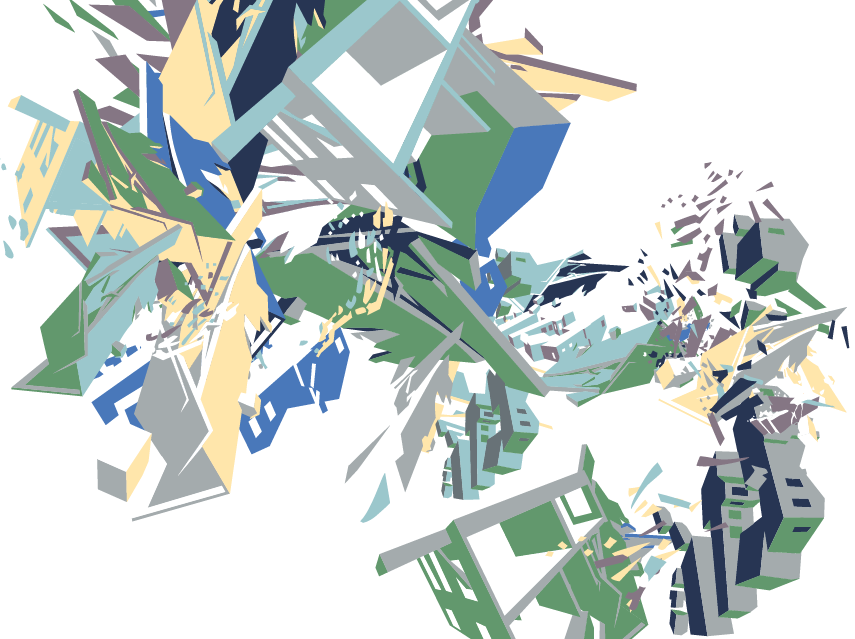
This Bldgblog post (link in title) is from 13 months ago but is fascinating, especially as it relates to the paintings I'm currently developing. In the spirit of Velocity Girl, the Smiths and countless other bands whose pop rhythms belie anger, so the colors from a pre-bubble bursting 2007 forecasts sooth the splintering content in the image above (study for a painting to be started tomorrow).

The houses grows out of my complicated history to home—my own tendency towards wanderlust, my curiosity about other nomads, and my father's history as the builder of homes. With the upcoming year yet again overseas, we'll see how this imagery evolves...especially as I leave Florida where emergency specialist express concerns about hurricanes transforming vacant homes into violent projectiles. Yikes.

Tuesday, July 06, 2010

Herzog & de Meuron


Architecture Photo Gallery: AD Special: Herzog & de Meuron by Duccio Malagamba – ArchDaily

Finally painting all day. The Vitrahaus reminds me of the housing forms I'm creating ...although Herzog & de Meuron's creation looks a little more barnacle buildup where mine are definitely exploded, reconfigured balls of grace.

Tuesday, June 08, 2010

Advertising - Speaking to Imagination and Emotion to Sell Paint - NYTimes.com

Advertising - Speaking to Imagination and Emotion to Sell Paint - NYTimes.com

As I continue to prepare The Sherwin Series for my Colorado State University exhibition, Denis Wood brought this NY Times article to my attention. Spot on.

Does anyone know the German equivalent to Sherwin Williams and Benjamin Franklin paints? I need the local pop culture references on top of my color research at the Bauhaus Archives.

Sunday, June 06, 2010

Expat Artists: The Creative Life Abroad � Expat Arts


Expat Artists: The Creative Life Abroad at Expat Arts

Another report on artists living overseas as we're about to spend a year in Berlin. Of course, there's a long history of this.

One example—Cy Twombly lives half his year in Lexington, Virigina and half in Rome, Italy and has done so for decades. I could totally do that. By the way, the Museum Brandhorst in Munich open May 2009. It has the most impressive Cy Twombly room I have seen, second to the the front room of the Cy Twombly Museum in Houston. Above is a picture that I took of the outside of the Museum last winter holiday break. Go visit!

UCSD Open Studios: James Enos


James Enos, The 2-Towers / Clairemont Erasure

UCSD Open Studios: James Enos

Reminds me of my housing forms...

Dance Review - Trisha Brown Dance Company - Melding Art, Architecture and Dance at Dia - Beacon - NYTimes.com

Dance Review - Trisha Brown Dance Company - Melding Art, Architecture and Dance at Dia - Beacon - NYTimes.com

What is BlogThis! ? - Blogger Help

Helps you blog about anything super-easy.

What is BlogThis! ? - Blogger Help

Expat Early Returnees Survey

A professor in Canada just asked me to post this survey. Hopefully you'll have some time to help her out.

Expat Early Returnees – Please Help!

Have you and your family ever returned home early from an international assignment? Do you know someone else who has? Dr. Nina Cole, an Associate Professor from Ryerson University in Toronto is inviting early returnees to participate in her study of early returns from home from the perspective of the families involved. This information is critical in order to help reduce the often-painful circumstances behind early returns through better pre-assignment preparation. Please visit http://ninacole.net before June 30, 2010 and click on ‘Expat Questionnaire’ (short, anonymous and confidential). Questions can be directed to Dr. Cole at n2cole@ryerson.ca. Your participation would be very much appreciated.

Friday, May 28, 2010

Katamari Damacy + Heinz Galinski School

I'm at the stage in my current project where mid-process, similar forms + unknown influences come to the foreground. Noting the following:

Katamari Damacy (Brian Alfred suggest it. Thanks Brian!)


Heinz Galinski School, Berlin, 1995, Zvi Hecker (1st Jewish school to be built in Berlin since WWII)


New work, Study for Sherwin's Virtual Re-Mix 05


Writing at http://joelledietrick.com/site/sherwin/
Draft(!) of catalog for Colorado State University solo exhibition (fall 2010) at http://www.blurb.com/bookstore/detail/1337954

Tuesday, May 25, 2010

Everything You Ever Wanted to Know But Were Afraid to Ask

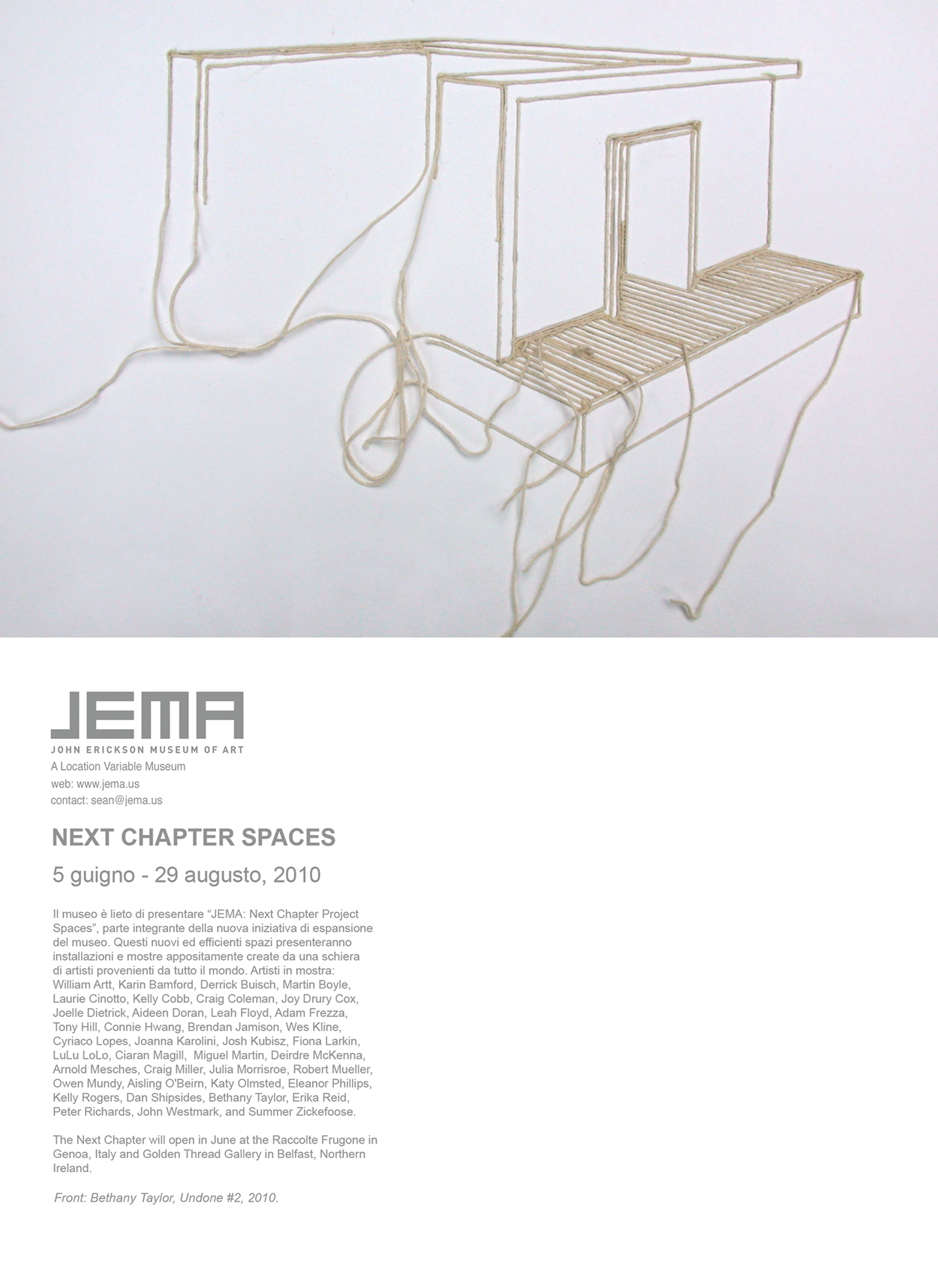
Owen Mundy and I sent images this week to two international group shows at the Golden Thread Gallery in Belfast, Northern Ireland, U.K. and the Raccolte Frugone Museum in Genoa, Italy. We were invited to submit proposals that “could not be realized” to Sean Miller, who curated the exhibitions as part of his John Erickson Museum of Art project.

Our process involved first constructing a 3-dimensional model of the space. Owen did this using Google SketchUp.


Then we filled this template with our proposals. Two variations resulted.

JEMA.3333, 11×8.5″, archival inkjet on paper, 2010


Everything You Ever Wanted to Know But Were Afraid to Ask, 11×8.5″, archival inkjet on paper, 2010


Exhibition card


Museum All-Over
June 4-August 29, 2010
John Erickson Museum of Art: Next Chapter and
Raccolte Frugone Museum
Genoa, Italy

Little Wonder
June 4-June 17, 2010
John Erickson Museum of Art: Next Chapter and
Golden Thread Gallery
Belfast, Northern Ireland
U.K.

Thursday, May 13, 2010

Thin Cities: New Favorites


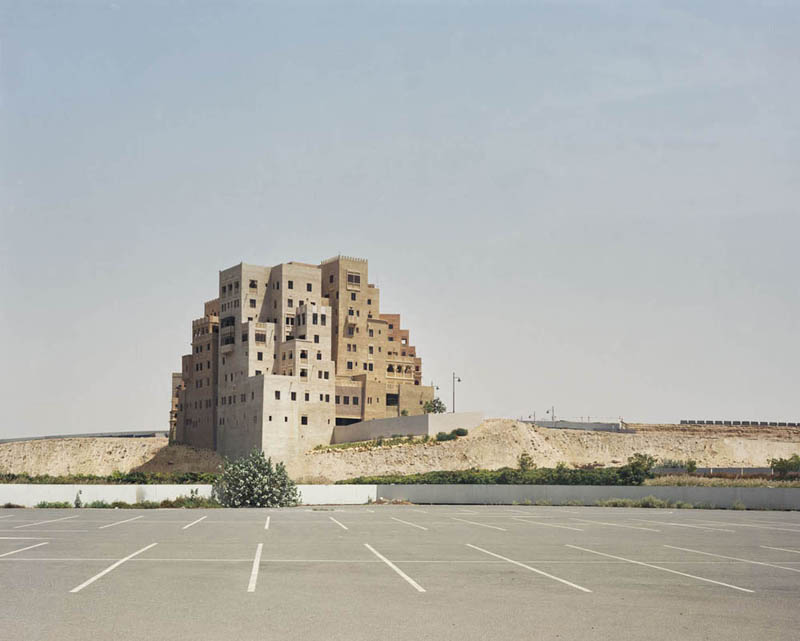
I have to bring Bldgblog to my readers' attention yet again. Look at these photographs by Bas Princen. They are in the same spirit as my Thin Cities series, but all the more powerful because they are real, on the outskirts of cities in unlikely arrangements. The Storefront for Art and Architecture writing about the photographs says it best.

Although it is the result of extensive travels and research in five cities of the Middle East and Turkey—Istanbul, Beirut, Amman, Cairo and Dubai—it could just as easily pass as the pictorial record of a dĂ©rive through a single, imaginary city: a city without a center, populated by extraordinary and at times implausible architectural artefacts; an urban laboratory whose physical traits are defined by migratory flows, spatial transformation and geopolitical flux on a continental scale.

Tuesday, April 13, 2010

Global Relocation Trends Just Released

Thanks for Andrea at expatwomen.com highlighting the latest trends in Brookfield's Annual Global Relocation Trends survey.

expatwomen.blogspot.com

Monday, March 08, 2010

This blog has moved


This blog is now located at http://female-expat.blogspot.com/.
You will be automatically redirected in 30 seconds, or you may click here.

For feed subscribers, please update your feed subscriptions to
http://female-expat.blogspot.com/rss.xml.

Tuesday, March 02, 2010

Elizabeth Gilbert on nurturing creativity | Video on TED.com

Comforting evening lecture...
Elizabeth Gilbert on nurturing creativity | Video on TED.com

Bldgblog Book


Phil Steinberg has been kind enough to lend me the Bldgblog Book, and I can't get enough of Geoff Manaugh's writing. Since the book consists of his blog posts on http://bldgblog.blogspot.com/ since 2004, you can easily dive into the book wherever you are inspired. I skipped ahead to and fell in love with the chapter called Redesign the Sky.

Although generally inspired by architecture, his approach to content is refreshing. As he describes in the intro:
In other words, forget academic rigor. Never take the appropriate next step. Talk about Chinese urban design, the European space program, the landscape in the films of Alfred Hitchcock in the span of three sentences -- because it's fun, and the juxtapositions might take you somewhere. Most importantly, follow your lines of interest.

Soon to talk about my own artwork in St Louis, I'm aware that leaps between seemingly disparate topics often drives my own practice. I hope I can communicate my brain's logic with the same convincing elegance as Manaugh.

Monday, February 08, 2010

Tallest Skyscraper by a Woman


Aqua by Jeanne Gang

Friend / blogger Jenn Mowery Marsh brought this New Yorker article and gorgeous piece of architecture by Jeanne Gang to my attention. Favorite bits from article in case you are in a rush...

- A lot of attention—in Chicago, at least—has been given to the fact that Aqua is the tallest building in the world designed by a woman. That’s nice for Gang, but beside the point, and dwelling on it leads too easily to predictable interpretations of skyscrapers as symbols of male identity...
- balconies on every floor, all the way up. Usually, condominiums sixty or seventy floors above the street don’t have balconies, because it’s just too windy up there to go outside...
- you might think it’s a gigantic version of one of those “blob” buildings of the past few year
- In an age in which so much architectural form—even, sometimes, the best architectural form—has no real rationale beyond the fact that it is what the architect felt like doing, there is something admirable about the tower’s lack of arbitrariness. It reclaims the notion that thrilling and beautiful form can still emerge out of the realm of the practical.

Read more at...

I see my revisitation of practically placed, undulating forms in my artwork's future.

Saturday, January 16, 2010

Hans Bellmer + Hysteria


Today I’m reading about Hans Bellmer and seeing parallels between his photographs and my recent paintings bulging with balls of figures and objects in domestic spaces. Therese Lichtenstein’s writing about Bellmer in a chapter called “The Hysterical Body” in her book Behind Closed Doors easily links Peter Kilborn’s Relos and expatriates’ nomadic tendencies. These commonly reward lifestyles appear normal but are often only seem slightly less frenetic and prone to emotional, animal-like behaviors. From page 108:

Once again, as in so many of Bellmer’s photographs, this body is riven by inner conflict...both trapped and out of control in the claustrophobic space. And once again, this headless hybrid creature (like octopus and a human combined) suggests the condition of hysteria. By portraying the doll as headless and flailing, Bellmer seems to collude with class nineteenth-century stereotypes of hysterics as woman who have lost their minds, who are emotional and animal-like in nature, and who are literally out of control.

Although the interpretations of hysteria and many of its symptoms have changed in various ways from Greek times to the present, and it has affected both men and women, hysteria has been consistently characterized as a female malady. What we call hysteria today is a psychosexual abnormality that manifests itself through an assortment of physical symptoms. The word hysteria derives from the Greek hyster (womb) and was used in ancient Greece to designate a pathology presumed to result from a displaced or “wandering” womb. The Greeks believed that in cases involving an insufficient amount of sexual intercourse or even sexual abstinence, the womb would become uprooted and wanter around the woman’s body, producing negative behavioral side effects. Women who did not conform to the conventional roles assigned in patriarchal culture—namely, wife and fertile mother—were pathologized...

In most Western cultures in the nineteenth century...according to diagnostic science of the period, the female hysteria registered her symptoms across her body through a nonverbal language f gestures that expressed her unconscious anger and rebellion. These passionate physical tremors, like the pent-up energy of an earthquake rocked her otherwise contained and controlled body.

Such antisocial characteristics were first “documented” in photographs taken under the direction of the famous French psychologist Jean-Martin Charcot at the Salpetriere clinic between 1875 and 1880...hysterical fits were induced by electrical shock, loud noises, pressure on the ovaries, the use of ether, tying women down, or placing their heads in a brace in order to hold a pose for the long exposure time. The cultural historian Sigrid Schade points out that it is not a coincidence that many nineteenth-century hysterical poses resembled epileptic fits, because after 1870 Charcot place epileptic patients and hysterics in the same ward. Many gestures, especially the “hysterical” arched back, resembled depictions of women possessed by demons or images of exorcism found in earlier medieval and Renaissance paintings. Charcot, who was married to a wealthy widow and wa sa patron of the arts, closely connected to Parisian art circles, collected these works and hung them on the walls of the Salpetriere clinic, where patients had visual access to them.


More about Lichtenstein's book at http://ucpress.edu/books/pages/8186.php
A 2006 New York Times article with a painting of Charcot talking about the "disappearance" of hysteria, a fashionable syndrome of the Victorian era...or the changing of its name. http://www.nytimes.com/2006/09/26/science/26hysteria.html

Saturday, December 19, 2009

Exact Coordinates of Home

"As far as one journey, as much as a man sees, from the turrets of the Taj Mahal to the Siberian wilds, he may eventually come to an unfortunate conclusion—usually while he's lying in bed, starting at the thatched ceiling of some substandard accommodations in Indochina," writes Swithin in his last book, the posthumously published Whereabouts, 1917 (1918). "It is impossible to rid himself of the relentless, cloying fever commonly known as Home. After seventy-three years of anguish I have found a cure, however. You must go home again, grit your teeth and however arduous the exercise, determine, without embellishment, your exact coordinates at Home, your longitudes and latitudes. Only then, will you stop looking back and see the spectacular view in front of you."

From Special Topics in Calamity Physics by Marisha Pessl. I'm having trouble finding the original source, but worthy of a post.

Wednesday, December 02, 2009

The Rotating Kitchen by Zeger Reyers

Also my inclination for making artwork right now. Spot on.

See documentation of Reyer's The Rotating Kitchen on vimeo.

Janine Antoni


Listening to some podcasts while I'm working at the artist residency in Austria. These comments from Janine Antoni from MOMA Reconsidering Feminism, buried somewhere in their iTunes Think Modern series, rang true today.

Gender is not something that I manufacture from a historical or theoretical perspective. It's actually something that surprises me in the work. It doesn't come from some sort of pre-conceived notion. It's is only the unconscious imagination that would wake up to find their mother dressed up as their father and vice versa. It’s only from this place that I can imagine doing the laborious task of mopping the floor with my hair or making lipstick out of six hundred pounds of chewed chocolate. It's sort of this confusion...this misunderstanding that I find illuminating... I'm not talking about a kind of non-thinking or idiot savant attitude, but I'm talking about...the unconscious as a kind of a product of the conscious mind...and the conscious mind that's done a lot of work on this issue that is very aware of the way that I'm treated in the world as a woman. A conscious mind that sort of watches how gender plays itself out in the world. It's my belief that in liberating the imagination is the only way that I can envision some other possibility.
Thursday, November 26, 2009

Plant Passport

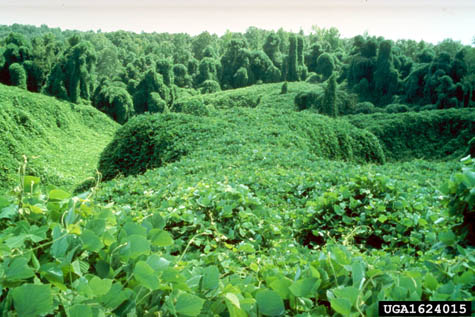
Much of the landscape where I've lived for the past three years, can look like this:


[Image: Kudzu-infested forest; photo courtesy John D. Byrd, Mississippi State University].

Even waterways, now becoming choked with Pondweed, make you wonder who has the upper hand. Occasionally plants appear to be winning, especially when the current economy yields little money to maintain infrastructure. Even during my first month in the region, plants started working their way into my paintings. Now they are really coming into themselves, like the plants barreling through Munich's Haupbahnhof in this recent painting:


Swarm Separating Self: Haupbahnhof Pondweed, Ink on vellum, 10x45 in, 2009


Swarm Separating Self: Haupbahnhof Pondweed, Ink on vellum, 10x45 in, 2009 (detail)

The dense, defiant roots of these plants stood in perfect contrast to the rootless female figures of my imagined worlds. But then this morning, to stumble upon on a fantastic conversation on Bldgbldg blog with Plant Health and Quarantine Officer for the Royal Botanic Gardens at Kew about Plant Passports...all this while reading Michael Pollan's Botany of Desire. I couldn't be more pleased.

Thursday, November 12, 2009

New Books on Painting


Katharina Grosse, Untitled, 2004, acrylic on wall, floor, and various objects, approx. 110 × 177 × 158 in (280 × 450 × 400 cm)

New books on painting:
Painting Today
Painting Abstraction

Both from Phaidon.

Off to Austria to work on my paintings. Hurrah!

Also from Painting Today

Matthias Weischer, Oberlicht, 2006, oil and egg tempera on canvas, 120 x 150 cm (47¼ x 59 in)

Sunday, October 11, 2009

Molly Springfield's Translation


My favorite exhibition during my recent trip to Chicago was Molly Springfield at Thomas Robertello Gallery. The artist painstakingly render the first chapter of Marcel Proust’s In Search of Lost Time. Working page by page, rendering even the type in graphite, the task took her two years and took my breath away. The space was bizarrely comforting, especially having just left my own labor-intensive recent artwork, pictured below. I'm happy with my new paintings, but still, go Molly...what a clear-headed, powerful gesture.

Tuesday, September 22, 2009

twocoatsofpaint.com


Mark Bradford, "Giant," 2007, mixed media collage on canvas, 102 x 144." Courtesy Sikkema Jenkins.

I'm enjoying this blog, http://www.twocoatsofpaint.com/

Go Mark Bradford with your genius grant.

Monday, August 10, 2009

Part Bicycle?

Anticipating our upcoming trip to Ireland packed with biking trips, our friend Sean Miller sent us this fantastic quote from Flann O'Brian's novel The Third Policeman, in which Sergeant Pluck addresses atomic theory in relation to bicycles:

The gross and net result of it is that people who spent most of their natural lives riding iron bicycles over the rocky roadsteads get their personalities mixed up with the personalities of their bicycle as a result of the interchanging of the atoms of each of them and you would be surprised at the number of people in these parts who nearly are half people and half bicycles. They go on to discuss percentages: apparently the postman, due to the nature of his job which involves much bicycle-riding, is a full 71% bicycle. This also means that his bicycle is 71% human. When it gets to this stage, the bicycle will start sneaking inside to sit by the fire, and food will start disappearing. "If you let it go too far it will be the end of everything," says the Sergeant. "You would have bicycles wanting votes and they would get seats on the County Council."
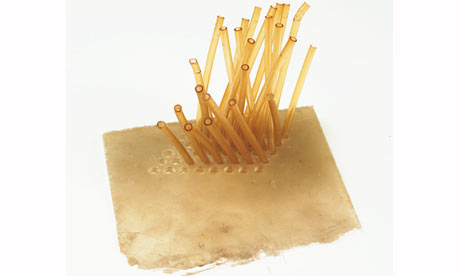

Must look into whether expatriates exchange atoms with planes. Surely they do with each subsequent location.

Wednesday, August 05, 2009

Eva Hesse, Immortal Longings


Immortal longings ... an untitled piece of Eva Hesse's Studiowork (1968). Photograph: Abby Robinson/Courtesy of Fruitmarket gallery, Edinburgh

Important to bookmark for later reference. I had never seen this Eva Hesse piece. Exhibition in Edinburgh. Article in The Guardian at http://www.guardian.co.uk/artanddesign/2009/aug/05/artist-eva-hesse

Tuesday, July 28, 2009

Reloville


After taking a brief break from books on transnationalism, I just ordered the following two books:

Next Stop, Reloville: Life Inside America's New Rootless Professional Class by New York Times writer Peter Kilborn

Interview with Kilborn on To the Best of Our Knowledge http://www.wpr.org/book/090712a.cfm

Leaving America: The New Expatriate Generation by John Wennersten

We'll see how they go...I also found this US News article updating numbers on American's abroad (4 to 7 million). They keep moving around so they are hard to count! http://www.usnews.com/articles/news/2008/07/28/a-growing-trend-of-leaving-america.htm

Friday, June 26, 2009

Anderson Ranch with Josh Davis


I've spent this week at Anderson Ranch studying with Josh Davis. Check out his work at joshuadavis.com. More soon on my website, but here's a still of my work here.

Many thanks to Anderson Ranch for helping me to study here. Nestled in the Rockies, it's an ideal artist oasis where everyone is kind and thrilled to be making art.

Friday, June 05, 2009

Ram Katzir and Pico Iyer


Ram Katzir, Tracing Future, 2005, floor engraving, 120 m2, Collection Herzliya Museum of Contemporary Art

Two days ago, I emailed artist Ram Katzir (http://www.ramkatzir.com) to find out more about Aomori Contemporary Art Center residencies (http://www.acac-aomori.jp/en/index.html). He highly recommended the program, noting the fierce competition to get in, and after looking at my work, suggested the literature of Pico Iyer. I thought I'd share both tips.

Tuesday, April 07, 2009

Original In Your Work

Be regular and orderly in your life, so that you may be violent and original in your work.
Flaubert (French writer, 1821-1880)

Friday, January 23, 2009

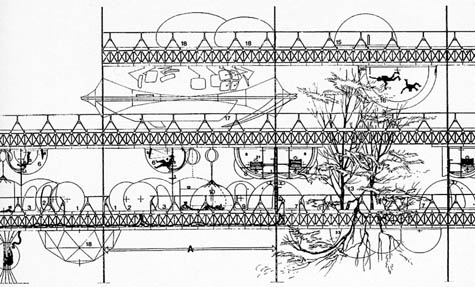
bldgblog


[Image: The Cable City of Takis Zenetos].


Another recommendation is my new favorite blog at http://bldgblog.blogspot.com/ Many thanks to FSU Geography Professor Phil Steinberg for this recommendation. Scroll down to read about Takis Zenetos. I see a cable city in my artmaking future.

Friday, January 16, 2009


Many thanks to Elisabeth Condon for her lecture last night at FSU. Check out her work at http://www.elisabethcondon.com. It's extraordinary and especially impressive after her move to Florida. Who knew warm weather could increase a flurry of creative activity? I thought that we all assumed the reverse. My favorite new phrase from her talk—rolodex space.

Her Parasol House series reminds me of my favorite show seen over the winter break—Al Held at Casey Kaplan. Those paintings were ahead of their time.