Begun during my adventures overseas, the Female Expat Project began as a collection of artworks about female expatriates and their original ideas about place. On the flip side of expatriates' nomadic lifestyles are contemporary nesting instincts—also explored in this blog. Really it's a publicly available sketchbook in the cloud supporting my artwork. http://joelledietrick.com
Friday, May 05, 2017
Thursday, May 04, 2017
100 Days on a Fulbright: Day 21: Love of Bldgblog
![]() |
| Image from Geoff Manaugh. The Washington Bridge Apartments, New York; via Google Maps. |
Linking directly to his post about the "constructed interior, as exotic as the savannah" at http://www.bldgblog.com/2017/04/corporate-gardens-of-the-anthropocene/. He always points out lesser noticed spaces in innovative ways. Hoping to take that approach to the Chilehaus, surrounding buildings and the city at large.
Tuesday, May 02, 2017
100 Days on a Fulbright: Day 20: Chilehaus
My proposal for my 3-country Fulbright to Germany, Chile and Hong Kong connects early 20th century buildings and their PR materials across national boundaries. Sometimes my process involves leafing through old magazines and newspapers. Other times, giving tours of the buildings and their surroundings. And on ideal days, like today, studio production, inspired by this research.
So to refocus before a studio day, a little bit more about the Chilehaus, my main muse (along with the port) here in Hamburg. Below is an excerpt from my proposal, explaining the connection.
Placed on UNESCO’s list of World Heritage Sites in 2015, the Chilehaus is a compelling, early example of infrastructure born out of the profits from international trade. Designed in the shape of a ship, the building cost a small fortune during Germany’s period of hyperinflation in the 1920s. Funded by shipping magnate Henry B. Sloman, Chilehaus developed from Sloman’s wealth amassed through his trading of potassium nitrate mined in Chile, hence the name Chile House. The Global Flex will allow me to investigate related public relation posters on both ends of the exchange, through examination of promotional materials about the Chilehaus at the University of Hamburg and the mining of potassium nitrate in Chile at the National Archive of Chile. The posters from both locations during this era display a national boosterism common in artwork from the Soviet Socialist Realist era.
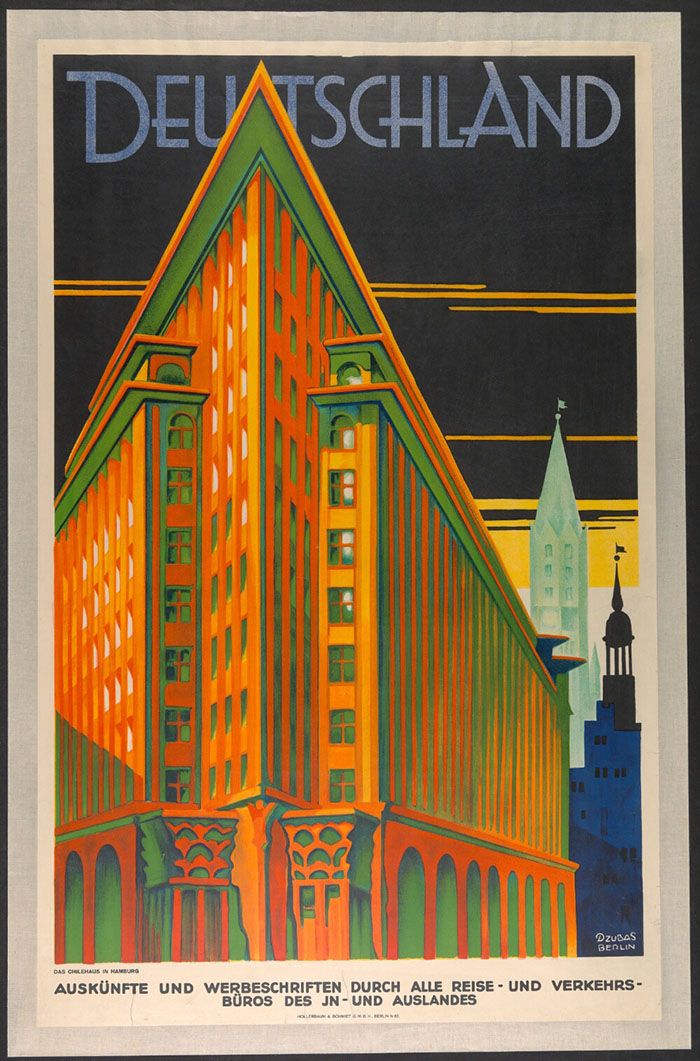
![]() |
Willy Dzubas. Deutschland : das Chilehaus in Hamburg. Published by Berlin : Hollebraum und Schmidt, [1919-1945].
|
And later in my proposal:
Since my recent artwork remixes color and architecture as ways to manufacture desire, this research on posters will be combined with investigations into the history of urban planning in Hamburg. The warping architecture in my artwork from the last ten years connects to both Chilehaus’ location in the Speicherstadt and Kontorhaus District, with its series of complex tunnels, canals, and warehouses, and the Chilehaus itself, with its sharp peak at its front that mimics a ship’s prow. These oblique structures, evident in Höger’s 1924 building and often celebrated in contemporary, computational architecture, mimic the both the intentionally obtuse structures of contemporary networked systems and the structure of the sea itself. Geographer Phil Steinberg writes that linear, descriptive narratives are inadequate for portraying trade, which is a process of betweeness even as it incorporates tangible objects, actors, and power dynamics. Furthermore, he argues that linear narratives are unable to capture either the social or the geophysical power of the ocean, which has a depth and dynamism that defies representation, or of the ports that exist in constant interchange between ideals of solid land and liquid sea. In keeping with this critique, I seek to produce artworks with structures that reflects this liminal state—between representation and abstraction, male and female, analog and digital—through paintings that suggest movement and short animations in motion.
100 Days on a Fulbright: Day 19
Bank holidays on a Monday in Germany are especially tricky with a six-year old: Everything but restaurants are closed. And she's weary of getting rained on at the playgrounds. Or getting pelted with hail. Perhaps we were all in a bad mood. So today was a day of serious catch up. Work done on our new computer lab in the Art Department at Davidson College. Needs a scanner. And some color. But soon it will be filled with mind-blowing, ambitious and smartly designed artworks.
Sunday, April 30, 2017
100 Days on a Fulbright: Day 18
![]() |
| Planetarium Hamburg, http://www.planetarium-hamburg.de/ |
Happy Labor Day / Tag der Arbeit!
100 Days on a Fulbright: Day 17
![]() |
| Slide: 7 / of 9 from January 2017 Wired article: The panels were slotted into place like pieces of a puzzle. Photo Ben Koren. |
A friend of ours went this last Saturday determined to get a ticket. For an 8 pm performance, she arrived at 6:30 to stand in line at the ticket shop for the few tickets (apparently about 30 for 60 people) made available just before the show. When the last ticket sold, she held a card saying that she was searching for tickets. And a subscription holder sold her one. So there is hope.
What's particularly exciting for me, as this Wired article from January 2017 describes, is the way that the building was designed. Having taught the history of computational architecture as part of my Art and Electronic Media class at Florida State University and now at Davidson College, visiting the Elbphilharmonie, is an ideal way to update that research. More from the Wired article about its design:
The auditorium—the largest of three concert halls in the Elbphilharmonie—is a product of parametric design, a process by which designers use algorithms to develop an object’s form...“That’s the power of parametric design,” he [acoustician Yasuhisa Toyota] says. “Once all of that is in place, I hit play and it creates a million cells, all different and all based on these parameters. I have 100 percent control over setting up the algorithm, and then I have no more control.”
![]() |
| Strategies for parametric design in the Elbphilharmonie by Korean acoustician Yasuhisa Toyota with Herzog and De Meuron |
![]() |
| Herzog and De Meuron, Elbphilharmonie, 2007–2016, Hamburg, Germany |
Saturday, April 29, 2017
100 Days on a Fulbright: Day 16
![]() |
| Model made in Blender. From http://architectureblender.weebly.com/ |
Friday, April 28, 2017
100 Days on a Fulbright: Day 15
![]() |
| Vito Acconci inside one of his modules for “Project for Klapper Hall,” from 1993-95.Credit Fred R. Conrad for The New York Times |
Sad to hear of Vito Acconci's passing. Much of his work resonates with me, including his unexpected turn to public art that plays with our expectations for architecture. Two quotes from the New York Times review about his life:
1) In reference to his "Following Piece" from 1969:
“It was sort of a way to get myself off the writer’s desk and into the city,” he once told the musician Thurston Moore. “It was like I was praying for people to take me somewhere I didn’t know how to go myself.”How I feel about my class at HFBK. It structures my research and forces me out of the studio to meet locals and see the city.
2) His career turn:
That ambition took hold fully in the mid-1970s, when, in a radical career turn, he abandoned the gallery world and remade himself as a highly unorthodox architect and designer, creating works like public parks, airport rest areas and even an artificial island on a river in Austria.
The move confused his peers and caused his profile in the art world to recede, to the point where many younger artists who were indirectly influenced by his work had little idea who had created it. In his later years, Mr. Acconci sometimes agonized over this situation, but he said he had no choice but to follow his interests where they took him — which was no less than an ambition to change the way people lived.3) His approach to architecture:
“I wish we could make buildings that could constantly explode and come back in different ways,” he said in one interview. “The idea of a changing environment suggests that if your environment changes all the time, then maybe your ideas will change all the time. I think architecture should have loose ends. This might be another problem with Modernism — it’s too complete within itself.”Why I'm studying the Chilehaus, but more about that in another post.
![]() |
“Murinsel,” a floating platform in Austria designed by Mr. Acconci. DeAgostini/Getty Images
CrediDeAgostini/Getty Images |
100 Days on a Fulbright: Day 14
Off to the University of Hamburg main library to get an overview of their collection.
The main entrance is at Von-Melle-Park 3 (the blue marker on this map).
Thursday, April 27, 2017
Wednesday, April 26, 2017
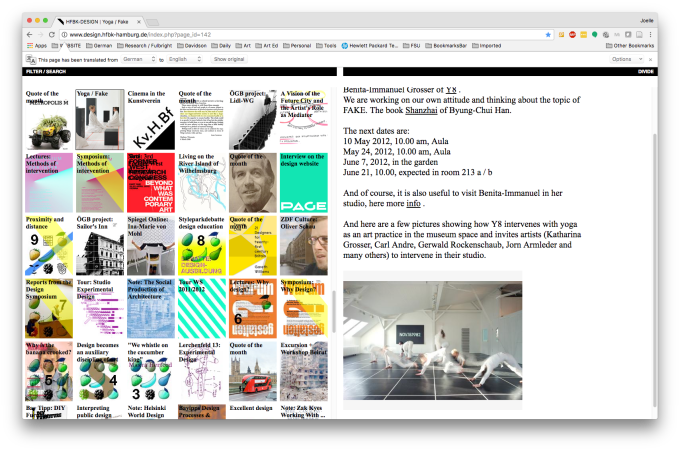
100 Days on a Fulbright: Day 12
![]() |
| Jesko Fezer, http://www.design.hfbk-hamburg.de/index.php?page_id=30 |
Reading about Jesko Fezer—head of HFBK Design focus, a popular professor here, pictured above in purple. Like many, he commutes from Berlin where he lives. Degrees at HFBK are interdisciplinary, but students chose a focus (listed here), and in the German tradition, study under one professor. All of the classes here are pass / fail. The students only have to pass a few classes, but many collect more credits than they need and are self-directed. Based on the quality of work at the graduation exhibition last summer 2016, this laid-back systems seems to be working surprisingly well.
Tuesday, April 25, 2017
100 Days on a Fulbright: Day 11
Monday, April 24, 2017
100 Days on a Fulbright: Day 10
![]() |
| Hafen City Tours, GrĂĽner Landgang / “Green” shore tour, http://www.hafencity.com/en/infocenter/guided-tours.html |
Tomorrow my HFBK class will go on the following tours about Hafen City and FRISE.
- 11:00: Tour of Hafen City with Thorsten Gödtel. Meeting at Sustainability Pavillon, Osakaallee 9, 20457 Hamburg
- 13:00: Travel to FRISE (Arnoldstrasse 26-30 22765 Hamburg (take 1:11 bus 111 along port from Osakaallee, direction Bf. Altona, 18 stops to Rathaus Altona) to meet Michael Kress at 14:00, Hamburg representative of Port Journeys (2011–present).
Sunday, April 23, 2017
100 Days on a Fulbright: Day 9
![]() |
| New gallery in Hamburg, Germany, 4'O Clock Light, More at http://www.4oclocklight.com/ |
Saturday, April 22, 2017
100 Days on a Fulbright: Day 8
![]() |
| Post-Internet Cities Conference, MAAT - Museum of Art, Architecture and Technology | Lisbon, 26 May 2017 |
Just booked a flight to Portugal the week before this conference, but I need to teach a class in Hamburg on the day this is happening.
Sharing the link in case somebody else out there wants to go. Looks great.
Friday, April 21, 2017
100 Days on a Fulbright: Day 7
![]() |
| Gästehaus der Universität Hamburg, March 2017, just before we arrived and they had a warm spell. |
Busy Friday so a short post. Our housing in Hamburg. Highly recommended in such an expensive city. You just need an affiliation with the university. schöne Wochenende!
Thursday, April 20, 2017
100 Days on a Fulbright: Day 6
![]() |
| Husband Owen and six-year old daughter Sophia on Easter Sunday at the Kunsthalle Hamburg during my Fulbright here. |
There were years, especially during job searches, where I hid the fact that I am a mother. In the States, questions about your family are illegal. Family takes you away from your professional commitments, true. But what people without kids do not realize is that it expands your world view, and your research, so profoundly, at a visceral level. I fought it for years, anticipating that motherhood would be the end of my career. And it wasn't. It caused me to be more focused, to prioritize. Ah but now the Fulbright. This long time dream. When I research "Fulbright with children," I found little advice or documentation. So as I struggle to focus on my Fulbright project and not worry about my daughter who currently hates her German school, I offer the reading the following link with excerpt about a mother who moved her children to Paris. This is hard on all of us, but worth it, I think.
We considered this question head-on in Paris, where the American School of Paris was one of our options for Kaitlin’s education in this city. Kaitlin and I visited together, and we both had the same reaction.
The American School of Paris could be the American School of Any American Town. Every student is from the States, as is every member of the faculty. English is the only language spoken. The curriculum, the calendar, the sporting events, the special events, the locker rooms... everything about the school is as it would be Stateside. Nothing wrong with this, per se, but it seemed a shame to us for Kaitlin to miss out on the chance to learn French, to make friends from all over the world…
here’s what I can tell you: Your children will be fine. The truth is, their move will be harder on you than it will be on them. They will learn the new language quicker than you will, they will make new friends more easily, and they will assimilate more readily.
If you let them.
Our first six months in Paris, Kaitlin would sit at the dining room table after dinner doing her homework—all in French. Before our arrival in this country, she’d never studied the language. Then, overnight, she was studying in the language, doing high school math in French. The work would take her hours, after which she’d retire, exhausted and nearly in tears.
Then she’d have to get up the next morning to return to school, where, again, all lectures, presentations, and course materials were in French. This shouldn’t be so hard on her, the mother in me couldn’t help but observe. I made an appointment to meet with her advisor at school, who said this:
“Kaitlin is struggling, yes. But you must let her struggle. It is good for her.”
This is the last thing a child wants to hear and the hardest thing for a parent to accept. But I tell you now, it is the right thing, the true thing. After six months of exhausting effort, Kaitlin was bilingual. She retains this asset, which, already, has opened doors for her.
Wednesday, April 19, 2017
100 Days on a Fulbright: Day 5
![]() |
| Hamburg Sud ship in the Port of Hamburg, sunny Sunday, April 9, 2017, photo by Joelle Dietrick |
Tuesday, April 18, 2017
100 Days on a Fulbright: Day 4
![]() |
| HFBK symposium this week on the Aesthetics of the Virtual. More info at: http://www.aesthetikendesvirtuellen.de/de/veranstaltungen/symposium-mediale-revolutionen |
Sunday, April 16, 2017
100 Days on a Fulbright: Day 3

In last Thursday's NYTimes, how one tax plan would tax imported goods but but exports. Having trouble finding online version of New York Times article. Trying to understand the impact on the shipping industry. Related reporting:
- New York Times on the Border Adjustment Tax, April 11, 2017
- CNBC, February 17, 2017
- The Economist, January 21, 2017
- Forbes, January 26, 2017
- Supply Chain Dive, February 6, 2017
Saturday, April 15, 2017
100 Days on a Fulbright: Day 2
![]() |
| Naeem Mohaiemen’s “Tripoli Cancelled” installation. Credit Mathias Völzke. From the New York Times review of 2017 Documenta in Athens. |
Friday, April 14, 2017
100 Days on a Fulbright: Day 1

- HFBK Archive of Recent Design Classes
- 100 days, Documenta as a Museum of 100 days
- 100 Days of a Presidency
- 100 Days Campaign, a publicity stunt by Amnesty International
- 100 Days' Offensive, Allied offensive on the Western Front WWI
- 100 Days' Reform, social reform in late imperial China
107 days left in my Fulbright and I will try to blog 100 posts.
Blogging felt relevant 10 years ago. As this Atlantic article explains, “Blogging — I mean, honey, don’t even say the word. No one actually blogs anymore, except maybe undergrads on their first week of study abroad.”
But for me, right now, it’s an easy lifeline to keep me productive during this challenging Fulbright. I have been working hard to get a Fulbright since 1995, when I took an independent study with Micaela Amato at Penn State with the sole purpose of getting one, and here I am 22 years later, 3-country Fulbright in hand. It has moved my whole family from sunny North Carolina (after we just transitioned there after my husband’s Fulbright to Austria) to a cold, rainy Hamburg where we live on top of each other, all sick with the flu. Surely it will get better, but in the meantime, this is my small goal: publish 100 posts.
This week in summary:
- First class at HFBK. I had no voice because of the flu. Only 6 students showed. The projected-movie-as-back-up plan could not be seen because of broken curtains. The students explained that they are not graded and will have to miss weeks here and there for travel. I am in culture shock but curious. It is a well-known art school. Wim Wenders, Thomas Demand, Marina Abramovic and many other well-known artists teach or have taught here. The art on view here last June 2016 was impressively high quality. Clearly they accomplish much without energy given to compulsory attendance or grades.
- Although our sick family-of-3 feels on top of each other in this city apartment, the Gästehaus der Universität Hamburg has been a good fit for our family. Last Wednesday evening, the Gästehaus team hosted a social hour where I met an economist from Poland, an American librarian studying Medieval block prints stored in amulets, and my favorite, Anna Stavrakopoulou, Associate Professor of Theatre Studies in Thessaloniki and Associate Director at Center for Hellenic Studies Harvard University. When I asked about her thoughts on Documenta, she lucidly described Germany and Greece’s complicated history. This morning, I read more in the New York Times review of the exhibition. I hope that she might participate in my HFBK seminar and we collaborate in the future. The Fulbright was formed in hopes that such connections would be established and flourish.
Wednesday, November 30, 2016
Monday, October 05, 2015
Friday, September 18, 2015
Wednesday, August 12, 2015
Anderson Ranch with Casey Reas
With the school year soon to go into full gear, I only have time for a short post on my recent workshop with Casey Reas at Anderson Ranch. Description from Casey is here: http://www.andersonranch.org/code-digital-fabrication-p1027-2/
For a more through description of the workshop, check out workshop classmate Simon Sarginson's post on Cyber Salon:
http://www.cybersalon.org/attending-code-digital-fabrication-at-anderson-ranch-with-casey-reas/
We had a fantastic group with a range of programming and fabrication skills. Everyone had something to offer. The week unfolded as follows:
For a more through description of the workshop, check out workshop classmate Simon Sarginson's post on Cyber Salon:
http://www.cybersalon.org/attending-code-digital-fabrication-at-anderson-ranch-with-casey-reas/
We had a fantastic group with a range of programming and fabrication skills. Everyone had something to offer. The week unfolded as follows:
- Monday: Processing intro with plotter + pen exercise
- Tuesday: Processing intro day 2 with plotter + vinyl exercise, laser cutter review
- Wednesday: CNC router review with blue foam exercise
- Thursday–Friday: Independent projects and crit
It was heavenly to be a student again, especially with Casey. He's extraordinary at working through ideas with code.
| Entrance to Anderson Ranch, photo by Joelle Dietrick |
![]() |
| Computer lab, photo by Simon Sarginson |
![]() |
| Fab lab, Donna Sweigart designing jewelry on felt, photo by Simon Sarginson |
![]() |
| Detail of Donna's design, photo by Simon Sarginson |
![]() |
| Ben Moren's plotter + pen design, photo by Simon Sarginson |
![]() |
| Simon Sarginson's maze on the laser cutter, photo by Simon Sarginson |
| Will Russack guiding us through the CNC Router exercise, photo by Simon Sarginson |
| Friday class crit, photo by Joelle Dietrick |
| Friday class crit, photo by Joelle Dietrick |
Tuesday, June 23, 2015
Jalal Tarazi on Life Teaching Overseas
My friend Jalal Tarazi just finished his book on Teaching Overseas. A fun read.
http://jtarazi74.wix.com/ jalaltarazi
http://jtarazi74.wix.com/
Saturday, March 28, 2015
Robert Yarber on Lapidus' Fontainebleau
About to talk at Penn State where I studied with Robert Yarber, Julie Heffernan and Micaela Amato. Stumbled upon VCU's interview with Robert Yarber: https://youtu.be/N_II9nPuhJk
When I really drawing floating figures in 2006, was it in part because Yarber bubbled up subliminally? Bizarre...
Wednesday, December 17, 2014
Kaldor Public Art Project: Thomas Demand
Kaldor Public Art Project Project 25
Thomas Demand (complete documentary) on Vimeo
- documentation of temporary projects
Monday, December 15, 2014
Empire
Empire: Excerpt from the 2-channel installation "Empire: 7 Degrees N 81 Degrees E" by Eline Jongsma & Kel O'Neill. Made as part of the project "Empire: Legacy of the World's First Corporation."
This excerpt tells the story of Herman Steur, a man whose charitable instincts led him to build a Dutch village in the middle of the Sri Lankan jungle.
Made as part of the project "Empire: Legacy of the World's First Corporation." Shot and exhibited in collaboration with Theertha International Artists' Collective, Colombo, Sri Lanka.
This excerpt tells the story of Herman Steur, a man whose charitable instincts led him to build a Dutch village in the middle of the Sri Lankan jungle.
Made as part of the project "Empire: Legacy of the World's First Corporation." Shot and exhibited in collaboration with Theertha International Artists' Collective, Colombo, Sri Lanka.
Friday, December 05, 2014
Monday, October 13, 2014
BLDGBLOG: We Can Terraform It For You Wholesale
Las Vegas development called Ascaya, in progress.
Wow. The construction site in our Orlando Museum of Art project on steroids.
Las Vegas development called Ascaya, in progress.
Wow. The construction site in our Orlando Museum of Art project on steroids.
Thursday, September 11, 2014
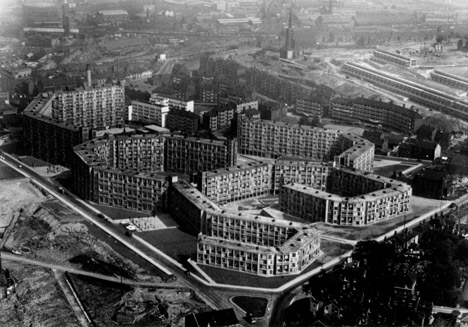
Brutalist buildings: Park Hill, Sheffield by Jack Lynn and Ivor Smith
| Park Hill housing estate in Sheffield, England, built after WWII. It brought "streets in the sky." |
Brutalist buildings: Park Hill, Sheffield by Jack Lynn and Ivor Smith
Thursday, August 21, 2014
Containers, Seaports, Sekula
| Allan Sekula and Noël Burch, still from The Forgotten Space (2010). |
After spending a summer writing about seaports and shipping containers, I'm bookmarking this article on Rhizome. http://rhizome.org/editorial/2014/aug/14/containers/
Interested to find out more...expat ladies, email me at jdietrick@gmail if you have any stories about ports, shipments, or your employers—anything that relates to global trade. It's for a 2015 summer project at MoCA Jacksonville's Project Atrium and a larger series. Past project documented by the extraordinary Sarah Emerson here: https://vimeo.com/71907184
Tuesday, April 29, 2014
Foreclosed Home Update
Oh to be at this conference at Columbia University this weekend. http://buellcenter.org/
Tuesday, December 17, 2013
Temporal Gerrymandering
▶ Geoff Manaugh at The Center for Design and Geopolitics - YouTube: http://youtu.be/MNzkl65pwtU?t=7m21s Playing with time zones to meet socio-political goals.
Quantitative Urbanism
Life in the City Is Essentially One Giant Math Problem in Smithsonian Magazine
| Dietrick + Mundy. The Sea is a Smooth Space. 2013. Single-channel animation. Dimensions variable. |
Thursday, December 12, 2013
Michelle Grabner on Curating the Whitney Biennial- BurnAway
Michelle Grabner, fearless as usual. "I am giving primacy to artists who are also teachers rather than young emerging artists. I looked at the artists who are teaching these young artists."
http://burnaway.org/michelle-grabner-give-talks-atlanta-nashville/